
A home that has worked well for 30 years may gradually become harder to move around in as we get older.
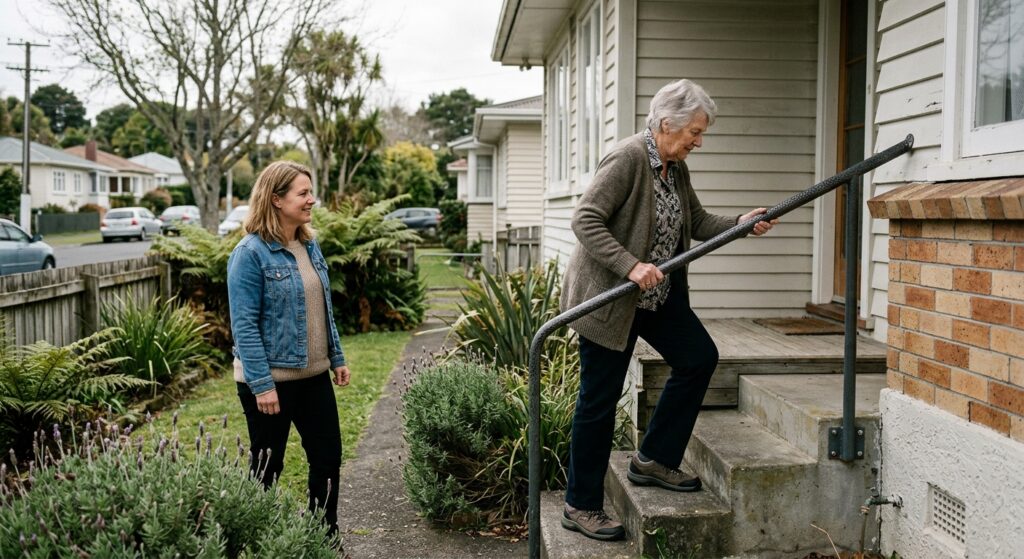
The front steps feel steeper. Getting into the shower takes more effort. A narrow doorway makes using a walker awkward. Or Mum has started holding onto the towel rail because there is nothing sturdy to support her beside the toilet.
For families, the first instinct is often to fix the problem. That might mean installing a handrail, replacing the shower or building a ramp.
But before arranging building work, there is another question worth asking: Could some of these home modifications be funded in New Zealand?
Depending on the person’s circumstances, funding may be available through Disability Support Services (DSS) or ACC. However, not every improvement qualifies, and the process usually begins with a professional assessment rather than a builder’s quote.
Understanding which modifications may qualify for funding can help families avoid unnecessary expenses and make changes that genuinely support independence.
✅ Quick Answer
Home modifications that may qualify for funding in New Zealand include handrails, access ramps, level-access showers, lifts and doorway alterations. Disability Support Services (DSS) may fund eligible disability-related modifications, while ACC may fund changes needed because of an accepted injury. Eligibility depends on individual circumstances, assessed needs and funding criteria. Families should talk to an occupational therapist or qualified housing assessor before arranging any major modifications.
What Counts as a Home Modification?
A home modification is a change to the physical environment that makes it easier or safer for someone to use their home. Unlike ordinary maintenance or decorating, home modifications are designed to address specific difficulties caused by a disability, injury or reduced mobility.
For example, replacing an old bathroom vanity because it looks dated is a renovation. Changing the bathroom layout because someone cannot safely enter the shower or manoeuvre a wheelchair is a disability-related modification. Understanding this difference is important when applying for funding.
Home modifications can range from small changes, such as installing fixed support rails, to larger projects, such as altering a bathroom or creating step-free access.
The aim is not necessarily to make every room fully accessible. It is to identify the barriers that prevent someone from safely managing essential activities.
Which Home Modifications May Be Funded in New Zealand?
Disability Support Services identifies several types of housing modifications that may qualify for assistance, depending on eligibility and assessed need.
| Home Modification | What It May Help With |
|---|---|
|
Handrails and support rails |
Using entrance steps or moving safely through particular areas |
|
Access ramps |
Entering and leaving a home without negotiating steps |
|
Level-access showers |
Showering without stepping over a raised shower tray or bath edge |
|
Platform lifts or stairlifts |
Moving between different levels where stairs create a significant barrier |
|
Doorway and wall alterations |
Allowing access for wheelchairs or other mobility equipment |
|
Disability-related safety fencing |
Reducing particular injury risks associated with a person’s disability |
These are examples of modifications that may qualify for funding, rather than changes that are automatically covered. An assessor considers what the person needs, whether the proposed work is appropriate and whether another solution could achieve the same outcome.
👉 Official resource: Modifying your house (govt.nz) · Disability Support Services: Equipment and Modification Services
Home Modifications and Mobility Equipment Are Not the Same Thing
Families sometimes assume that anything making a home safer falls into the same funding category. However, there is an important difference between making changes to the home and providing equipment that helps someone manage everyday activities. A fixed ramp or widened doorway is a home modification. A shower chair, walking frame or portable bath board is generally considered equipment. That distinction affects how solutions are assessed and funded.
When Equipment May Be the Better Option
Consider an older man who finds it difficult to stand for the duration of his shower. The family initially thinks he needs a complete bathroom renovation. However, an occupational therapist may find that suitable shower equipment and correctly positioned support rails would address the immediate difficulty without rebuilding the room. In another home, the shower entrance itself may be inaccessible, making a structural alteration more appropriate.
The right solution depends on the person, their home’s layout and the activities they find difficult.
👉 Read more: Mobility Changes in Older People: When to Get Support.
Who Can Receive Funding Through Disability Support Services?
Disability Support Services provides Equipment and Modification Services to eligible disabled people in New Zealand. According to DSS guidance, eligibility can include people with physical, intellectual, sensory or age-related disabilities. The person must also meet other criteria, which may include the following:
Have a long-term disability expected to continue for at least six months
Need specific modifications to manage everyday activities
Meet the relevant residency requirements
Have a disability that is not already covered by ACC
Simply being older does not automatically make someone eligible for funded home modifications. A person aged 85 who wants a more modern bathroom is in a different situation from someone whose long-term disability prevents them from safely using their existing bathroom. The assessment focuses on the functional difficulty and the proposed solution, not simply the person’s age.
Families should also be aware that not every mobility difficulty associated with ageing will qualify for funding. The assessor and funding agency determine whether the individual meets the applicable criteria.
What if the Need for Modifications Comes From an Injury?
When an older person’s difficulties result from an injury accepted by ACC, the funding pathway may be different. For example, Dad may have sustained a serious injury that affects his ability to enter the house or use essential rooms. If the injury creates a long-term need for changes to the home, ACC may arrange a housing modification assessment.
ACC considers whether the proposed work is necessary to address the injury-related limitations and support independence. Depending on the assessment, solutions may include equipment, minor modifications or more substantial structural changes.
How ACC Housing Modifications Work
- Identifying the injury-related difficulty.
- Arranging an appropriate housing assessment.
- Considering whether equipment or another solution would meet the need.
- Developing a modification proposal where structural work is necessary.
- Obtaining ACC approval and completing the approved work.
ACC states that approved injury-related housing modification services are fully funded, although a person may choose to contribute towards additional features or changes that are not required for the covered injury.
ACC funding is tied to the accepted injury and assessed rehabilitation needs. It does not cover general home renovations.
👉 Official resource: ACC housing modifications (Enable New Zealand)
Why an Occupational Therapist Should Be Involved Early
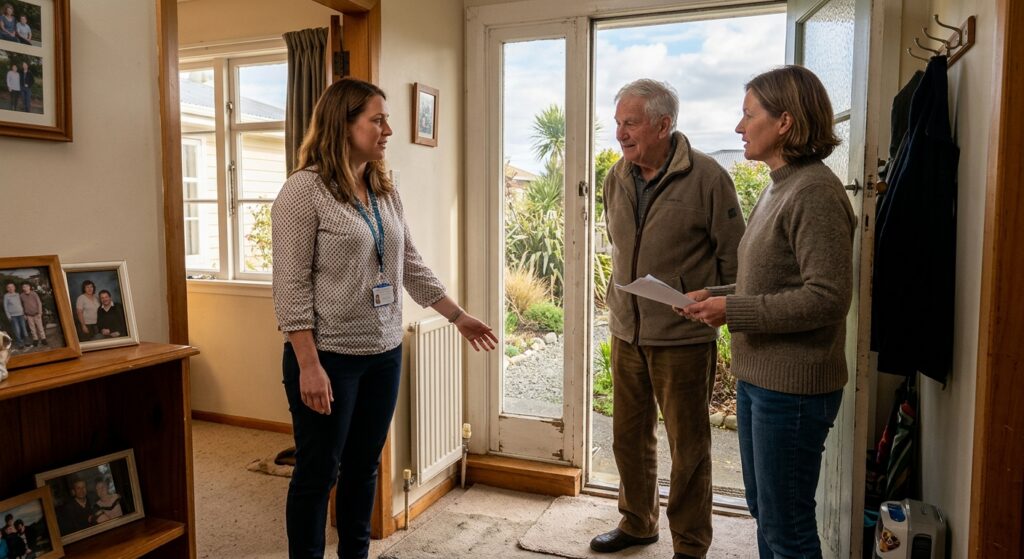
An occupational therapist, often called an OT, looks at how a person’s health or disability affects everyday activities. For home modifications, this means considering how the person actually uses their home. Rather than focusing only on measurements or the layout of the home, an OT may want to understand:
- how Mum approaches the entrance
- whether she can turn safely with her mobility aid
- how she transfers on and off the toilet
- whether the shower can be used independently
- how much physical assistance another person provides
- which rooms are essential to everyday life
- whether the proposed change will remain useful as needs evolve
An appropriately qualified housing assessor can then recommend suitable modifications and guide families through the relevant funding process. Not every occupational therapist can carry out all types of funded housing assessments, so families should check that the person they choose has the appropriate qualifications and approval.
How to Request an Assessment
A practical starting point is to speak with Mum or Dad’s GP or healthcare provider about a referral. Other options include contacting local community health services, needs assessment services or an appropriately qualified occupational therapist. For privately arranged assessments, families should check whether the therapist is qualified to assess housing modifications for the relevant funding scheme. See Enable New Zealand: DSS funding.
How to Apply for Home Modification Funding
The process varies according to the funding pathway and complexity of the work. However, for DSS-funded modifications, families can generally expect the following stages.
- Step 1: Identify the specific difficulty. Describe what the person cannot safely or independently do. For example: “Mum can walk around the house with her walker, but she cannot get through the bathroom doorway without turning sideways and losing her balance.” This provides more useful information than simply saying the bathroom needs to be renovated.
- Step 2: Arrange an appropriate assessment. An assessor considers the person’s needs, the layout of the property and possible solutions. They may recommend equipment, a smaller modification or more extensive building work.
- Step 3: Confirm funding eligibility. The proposed modification is considered against the relevant funding criteria. Depending on the funding scheme and the cost of the work, financial information or a household contribution may be required.
- Step 4: Develop the proposed modification plan. More substantial work may involve measurements, building plans, quotations and specialist contractors. Families should understand which parts of the proposal are included in the funding decision.
- Step 5: Obtain approval before work begins. This is an important step, as starting work before receiving approval may affect eligibility for DSS funding. Do not assume that submitting receipts afterwards will result in reimbursement.
- Step 6: Complete the work and check that it meets the need. Once the approved work is complete, the modification should be checked to ensure it meets the agreed requirements.
Will the Government Pay the Full Cost?
Not always. Under DSS, funding may cover the full cost of an eligible modification or only part of it, meaning the homeowner may need to contribute. The outcome depends on the circumstances and funding rules. For some higher-cost modifications, an income and cash asset test may be required. This is carried out through Work and Income as part of the DSS process.
Families may also need to cover additional costs if they choose features or building work beyond what the assessor recommends. For example, an accessible shower may be assessed as necessary, but a complete luxury bathroom renovation would not automatically be included. What is approved for accessibility may be quite different from the renovation the family has in mind.
Because financial thresholds and funding rules can change, families should check current DSS guidance rather than relying on figures from older articles.
Which Home Improvements Are Usually Not Funded?
It is also important to understand which improvements are unlikely to qualify for funding. DSS identifies several types of work it generally cannot fund, including:
- modifications costing less than $200
- work completed before funding approval, unless an exception applies
- ordinary household fittings
- general property maintenance
- short-term changes that would not support continued use of the home for the required period
- repeat modifications previously funded, except in certain circumstances
For example, replacing worn flooring throughout the house is generally a maintenance or renovation issue. However, a particular alteration required to address an assessed disability-related access problem may be considered differently. The important distinction is whether the work is necessary to address an eligible functional need.
Simply describing a renovation as a safety improvement does not automatically mean it will qualify for funding.
What About Simple Changes Like Lighting and Loose Rugs?
Not every home safety improvement needs formal funding. Many everyday hazards can be addressed without structural work. Examples include:
- moving electrical cords away from walking routes
- securing or removing loose rugs
- improving lighting around steps and hallways
- keeping commonly used items within easy reach
- removing unnecessary clutter
- ensuring walking routes remain clear
- repairing damaged or uneven surfaces
These small changes can make a real difference, especially when someone is becoming less steady on their feet. However, simple improvements should not replace professional assessment where there are repeated falls, significant mobility difficulties or uncertainty about safe movement. ACC’s home safety guidance encourages practical measures such as keeping walkways clear, securing mats and ensuring stairs are well lit.
Should You Install Grab Rails Yourself?
Grab rails may seem simple to install, but where they are placed and how securely they are fitted can make a big difference. A rail placed too high, too low or in the wrong location may not provide useful support. Likewise, a rail that is not properly fixed into suitable structural support can become dangerous when someone puts their weight on it.
The safest position depends on the person’s height, strength, movement patterns and the task involved. For example, the support needed when stepping into a shower may be different from the support needed when standing from a toilet. Families should seek appropriate professional advice about positioning and installation, particularly when the person has significant mobility difficulties.
Remember, a towel rail is not a substitute for a properly installed grab rail.
What if Mum or Dad Rents Their Home?
If Mum or Dad rents their home, there are a few extra things to consider, as permanent modifications affect the landlord’s property. Families should establish whether the proposed change requires the landlord’s consent and what tenancy requirements apply. For funded modifications, the assessor and relevant funding agency can help explain the process and what permissions are needed. Before arranging work, clarify:
- whether the landlord has approved the modification
- who will arrange the installation
- who will maintain the modification
- whether it must be removed at the end of the tenancy
- who will pay for any removal or reinstatement
These details are particularly important for ramps, bathroom alterations and changes to doors or walls. Even if a modification would make life easier for the tenant, it still needs to be properly authorised and installed.
What if the House Is Difficult or Expensive to Modify?
Not every property can be adapted easily. A steep driveway, a narrow internal layout, multiple levels or limited space can make major modifications more complicated. In some cases, the cost of making changes may outweigh the benefits. However, that does not necessarily mean Mum or Dad needs to move. The family and assessor may simply need to consider other options. These could include:
- using a different entrance
- rearranging how rooms are used
- moving essential activities to one level
- using suitable equipment
- making smaller targeted changes
- considering whether another property would better meet long-term needs
The priority should always be the person’s safety and independence, rather than trying to preserve every feature of the existing home.
How to Prioritise Home Safety Changes Without Renovating Everything
When families first notice safety problems, they may feel the need to fix everything at once. However, starting with the most important areas and making changes gradually is often more practical.
Priority 1: Problems Affecting Essential Daily Activities
Focus on whether the person can safely:
- enter and leave the home
- use the toilet
- shower
- reach the bedroom
- move between essential rooms
These are often the most important barriers to investigate.
Priority 2: Problems That Can Be Solved Without Building Work
Consider whether equipment, rearranging furniture or changing how a task is completed would help. An OT can assist with identifying suitable solutions.
Priority 3: Longer-Term Accessibility
If a person’s condition is likely to change over time, it may be worth thinking ahead about what support they could need in the future. For example, a doorway alteration may be more useful if it allows access for the mobility equipment they are likely to need. However, families should avoid making assumptions about future disability without appropriate advice.
Priority 4: General Comfort and Renovation Preferences
New cabinetry, decorative flooring or a modern bathroom design may be desirable, but these are different from essential disability-related modifications. Separating the two helps keep funding applications focused.
A Practical Example: Making a Bathroom Safer Without Losing Independence
Consider Helen, who is 83 and lives in her own home in Christchurch. She can still manage most daily activities, but stepping over the raised edge of her shower has become difficult. Her daughter wants to replace the entire bathroom immediately.
Instead, they arrange an occupational therapy assessment. The assessor looks at how Helen enters the shower, whether she can stand safely and what equipment or modifications may help. The assessment might identify a suitable equipment solution, fixed support rails or a need for a level-access shower. If structural work is recommended, the family can then explore whether Helen meets the relevant funding criteria.
The best solution is not necessarily the one that looks most appealing in a renovation catalogue. What matters is helping Helen use her bathroom as safely and independently as possible.
Home Modifications Still Need to Work in Everyday Life
A safer physical environment can make a significant difference. But even a well-designed home does not remove every difficulty. An older person may have an accessible shower yet still find washing and dressing exhausting. A ramp may make the front entrance easier to use, but shopping and carrying groceries may remain difficult. A wider doorway may improve mobility, while meal preparation still requires considerable effort.
This is where practical home support can complement physical changes. Home modifications can remove physical barriers, while home care can help with everyday activities that remain difficult. Together, they can make daily life safer and more manageable.
👉 Read more: Home Help for Older People in NZ: A Complete Guide or see Home Carers pricing.
New Zealand Organisations That Can Help
Before contacting a builder, it is worth finding out what support and funding options may be available. Several organisations can provide information or help identify the appropriate assessment pathway.
| Organisation | When It May Be Useful |
|---|---|
|
Health New Zealand |
Information about occupational therapy, home equipment and assessment pathways |
|
Disability Support Services (DSS) |
Eligibility and funding guidance for disability-related equipment and housing modifications |
|
ACC |
Assessment and potential funding for modifications required because of an accepted injury |
|
Enable New Zealand |
Equipment and modification service information and administration |
|
Accessable |
Equipment and modification service information, particularly for Auckland and Northland |
|
Occupational Therapy New Zealand |
Finding an occupational therapist with relevant experience |
For families in Christchurch, Tauranga or elsewhere in New Zealand, the starting point may differ depending on the person’s circumstances. Enable New Zealand lists Canterbury and the Bay of Plenty among the regions it covers for ACC housing modifications. A good place to start is by asking:
“Who can assess this particular difficulty and advise whether funding is available?”
A Safer Home Should Still Feel Like Home
When families worry about an ageing parent’s safety, it is natural to want to fix everything. But a safer home does not need to look like a hospital. Often, the most valuable changes are those that help Mum or Dad continue doing familiar activities safely and independently.
A properly positioned rail may help Mum continue using her bathroom safely. A ramp may make it easier for Dad to get outside, while a wider doorway could help someone move between rooms more independently. And sometimes, the right answer is not building work at all. It may be a suitable piece of equipment, a different way of arranging the room or a little extra help with everyday tasks. The first step is to understand what is becoming difficult before deciding how best to help.
Home Carers supports older New Zealanders who want to remain comfortable and independent in familiar surroundings. Practical assistance with meals, shopping, household routines, mobility, companionship and daily activities can complement home modifications and other professional support.
The goal is to remove unnecessary barriers while helping older people maintain as much independence as possible.
If Mum or Dad’s home is becoming harder to manage, begin by identifying which activities are causing difficulty and seek an appropriate assessment where needed.
🔗 MORE FROM OUR BLOG
- Repeated Falls in Older People
- How In-Home Physiotherapy Supports Recovery for Older Adults in New Zealand
- Moving Safely, Living Confidently: How Mobility Services Ltd and Home Carers Support Independence at Home
- The First 2 Weeks After Hospital Discharge Are Critical
- Moving Forward Together: How The Mobile Physio & Home Carers Support Recovery and Independence
Not Sure Where to Start With Mum or Dad’s Home Safety?
If Mum or Dad is finding everyday activities more difficult, start by looking at what has changed and where they may need support. This can help you decide whether an assessment, mobility equipment, home modifications or practical home care might make a difference.
At Home Carers New Zealand, we provide flexible, personalised home care to help older people stay safe, comfortable and independent in their own homes. Whether you need support now or are planning ahead, we’re here to help you explore the next steps.
Get in touch with our friendly team to discuss what might work best for your family.
YOU CAN ALSO REACH US DIRECTLY
Frequently Asked Questions
Can home modifications be funded before someone has had a fall?
Potentially, yes. A previous fall is not necessarily required. What matters is whether the person has an eligible disability-related need and whether the proposed modification meets the funding criteria.
Can funding be approved for just one part of a larger renovation?
Possibly. The funder may consider the modification required to address an assessed need, while the homeowner pays for unrelated improvements. The scope and cost responsibilities should be agreed before work begins.
Can a family choose its own builder?
It depends on how the modification is being funded. DSS has specific rules about contracted builders and cost contributions, while ACC uses its own approved processes. Families should confirm requirements before engaging a contractor.
What happens if the assessor recommends something different from what the family wants?
Families can ask the assessor to explain why a particular solution has been recommended and how it meets their loved one's needs. They can also discuss any concerns or preferences, but additional or alternative work may not be fully funded.
Are temporary modifications treated differently from permanent ones?
They can be. Funding schemes consider whether the solution is appropriate for the expected duration of need. Temporary equipment may be more suitable than structural changes during a short recovery period.
Who pays to maintain a funded modification after installation?
Responsibility depends on the scheme and type of modification. For DSS-funded building modifications, the homeowner generally becomes responsible for later repairs, replacement or removal. Families should clarify ongoing responsibilities before work begins.
Can a home be assessed before deciding whether to renovate or move?
Yes. An appropriate housing assessment can help identify accessibility barriers and potential solutions. The findings can help families decide whether it makes more sense to modify the current home or look for somewhere more suitable.
What if the family has already paid for the modification?
Retrospective DSS funding is generally not available for work completed before approval, except where specific exceptions apply. Families should contact the relevant agency for advice rather than assuming reimbursement is possible.