
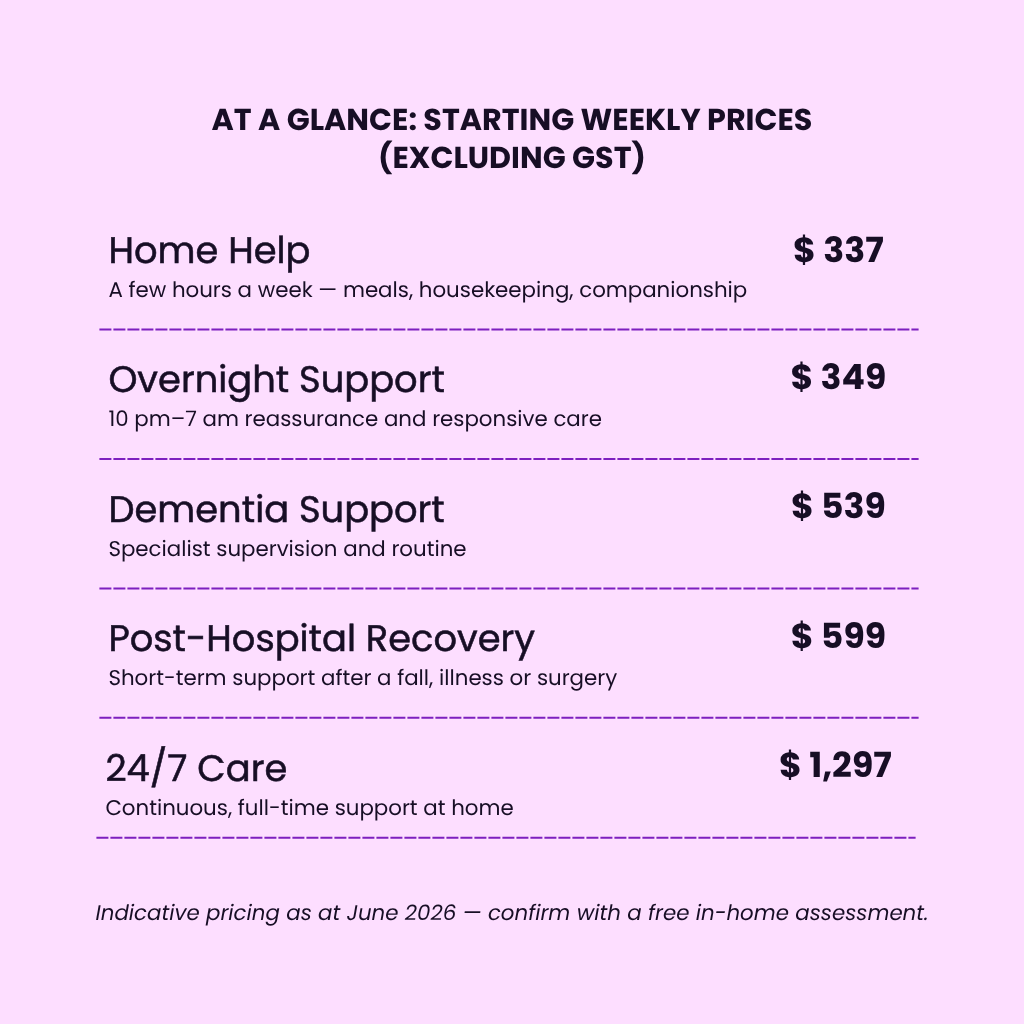
Budgeting for home care without running out of money comes down to three things: knowing your actual weekly cost (not just the advertised hourly rate), finding out what a NASC needs assessment can realistically fund, and building a 12-month cash flow instead of relying on a single weekly figure. In Christchurch and Tauranga, private home care typically starts from $337 a week for a few hours of home help, rising to $539 a week for dementia support and $1,297 a week for full 24/7 care. Most families start with fewer hours than expected, then adjust them as needs change.
By the time most families start comparing home care providers, the hard part already feels done. You’ve had the conversation, weighed up the options, and decided that Mum or Dad is better off staying in their own home rather than moving into a facility. Then the quotes start arriving, and a new kind of stress sets in — not, “Should we do this?”, but, “Can we afford to keep doing this?”
It’s a fair question. Home care costs in Christchurch and Tauranga aren’t always presented the same way from one provider to the next. One quote is per hour, another is a weekly package, and a few only reveal extras like weekend rates or setup fees once you’ve already started the conversation. Add in the uncertainty of how long support might be needed — months, or several years — and it’s easy to see why so many families worry about running out of money before their parent’s care needs are met.
This guide walks through what home care actually costs right now, the costs families often forget when comparing providers, what public funding through a NASC needs assessment can realistically cover, and a practical, step-by-step way to build a budget that holds up over the long run — not just for the first invoice.
What Home Care Actually Costs in Christchurch and Tauranga
Most home care pricing in New Zealand is built around an hourly rate, but very few families end up paying by the hour alone. In practice, providers package support into weekly tiers based on the type of care involved, which makes budgeting easier once you know what’s actually included.
As a general guide, private home care across Christchurch and Tauranga currently starts from around $53.97 an hour (excluding GST), with most ongoing support arranged through weekly packages rather than single visits.
Home Help Package: A few hours a week for meals, light housekeeping, and companionship typically starts from $337 a week.
Specialist Dementia Support: This requires more experienced carers and closer supervision, starting from around $539 a week.
Overnight Support: Sits around $349 a week.
Post-Hospital Recovery Support: Starts from $599 a week.
Full 24/7 Care: Where a carer is present around the clock, this starts from $1,297 a week.
How Home Care Compares to Other Care Options
| Care Option | Typical Weekly Cost | What's Included | What to Watch For |
|---|---|---|---|
|
Private Home Care |
From $337 per week |
Flexible hours, scheduled visits, home help to 24/7 support |
Setup fee, weekend/holiday surcharges, travel |
|
Rest Home |
From $1,500+ per week |
Room, meals, some care support |
Extra charges for outings, therapies, personal items |
|
Retirement Village |
Purchase from $659,000 + $175.83 per week fees |
Accommodation, community facilities |
Ongoing fees, resale loss, limited personal care |
|
Hospital-Level Care |
From $2,000+ per week |
24/7 nursing support |
Shared rooms, waitlists, loss of independence |
Table 1: Indicative weekly costs across common care options for older people in Christchurch and Tauranga. Figures are starting points and vary by provider and need.
Most providers also apply a minimum visit length — commonly three hours — which matters when comparing a “low” hourly rate against a provider that allows shorter, more frequent visits.
These figures are starting points rather than fixed totals. The real cost depends on how many hours are needed each week, the complexity of care, and whether support is needed on weekends, public holidays, or at short notice — all covered in the next section.
The Costs Families Often Forget to Budget For
The advertised hourly rate is rarely the full picture. Most families budget the headline number, then get caught out by add-ons that weren’t explained clearly upfront — not because providers are hiding them, but because they are easy to miss when comparing quotes quickly.
Here’s what’s worth building into the budget from day one:
- One-off setup fee: A one-time administration fee, commonly around $197 plus GST, covers onboarding, care plan setup, and the initial carer match.
- Weekend surcharge: Many providers apply a surcharge, often around 15%, for support between Friday evening and Monday morning.
- Public holiday surcharge: Expect a higher surcharge, often around 20%, for care provided on public holidays.
- Emergency or short-notice care: If support is needed within a day or two, a significant surcharge, sometimes as high as 50%, can apply.
- Travel and mileage: Reasonable travel costs are usually charged at the IRD mileage rate, though responsible providers cap this for travel to and from your parent’s home (commonly around 15km each way) to keep it predictable.
- Minimum visit length: A three-hour minimum is common, which affects the maths if you only need an hour or two at a time.
None of these costs are unreasonable in isolation. The problem is budgeting without them — which is how a “$337 a week” plan quietly becomes $420 in a week that includes a public holiday and a short-notice request.

What NASC Funding Can and Cannot Cover
Before committing to a fully private budget, it’s worth understanding what public funding might cover. In New Zealand, access to government-funded home support is arranged through a Needs Assessment and Service Coordination (NASC) process, managed on behalf of Health NZ – Te Whatu Ora. A GP, hospital discharge team, or the family itself can usually initiate a referral.
A NASC assessment looks at your parent’s day-to-day needs — mobility, personal care, cognitive support, and safety — and determines whether they are eligible for funded home support hours and, if so, how many. For some families, this covers a meaningful slice of their weekly needs. For others, particularly where dementia supervision, overnight care, or 24/7 support is involved, funded hours rarely stretch far enough on their own.
Two practical realities are worth planning around:
High Demand: Demand for NASC-funded support is high, and waiting times for an assessment — and for funded hours to actually start — can be longer than families expect, particularly straight after a hospital discharge.
Fixed Allocations: Funded hours are usually allocated based on assessed need rather than family preference, which means continuity of care or flexible scheduling isn’t always guaranteed through the public pathway alone.
This is why many Christchurch and Tauranga families end up using a blended approach: applying for a NASC assessment to see what’s available, while arranging private home care either as a top-up or as the main source of support while waiting. Organisations such as Age Concern NZ and Carers NZ are also useful starting points for understanding entitlements and support for family carers. Knowing this early, rather than assuming public funding will cover everything, is one of the most important steps in building a budget that doesn’t fall short.
A Step-by-Step Way to Build a Home Care Budget
Budgeting for home care works better as a process than a single calculation.
Here’s a practical sequence that holds up whether your parent needs a few hours a week now or is likely to need more later.
- Start with a free in-home assessment, not a guess: An accurate hours estimate, based on an actual visit rather than a phone quote, is the single biggest factor in getting the budget right from the start.
- Separate one-off costs from ongoing costs: List the setup fee separately from the weekly running cost, so you’re not comparing a “first week” total to an “ongoing week” total by mistake.
- Check NASC eligibility before locking in a fully private plan: Even partial funding changes the weekly number meaningfully over a year.
- Use loyalty and referral discounts where available: Booking three to six months in advance can reduce ongoing costs by 5–10%, and a referral can take 10% off a first invoice.
- Model twelve months, not one week: A weekly figure hides the impact of public holidays, seasonal surcharges, or a short period of higher-need care after a fall or hospital stay. A rough annual figure gives a far more honest picture.
- Set a review point every three to six months. Needs change, sometimes up and sometimes down, and a fixed review date helps avoid both overpaying for unused hours and under-budgeting for new ones.
To make this concrete, here’s roughly how the weekly packages translate into a monthly figure, based on current starting prices:
Estimated Monthly Costs at a Glance
| Package | Starting Weekly Price | Approx. Monthly Total* | Best Suited For |
|---|---|---|---|
|
Home Help |
$337/week |
~$1,460/month |
A few hours a week of practical support |
|
Overnight Support |
$349/week |
~$1,510/month |
Reassurance through the night (10 pm–7 am) |
|
Dementia Support |
$539/week |
~$2,335/month |
Specialist supervision and routine |
|
Post-Hospital Recovery |
$599/week |
~$2,595/month |
Short-term support after a fall, illness or surgery |
|
24/7 Care |
$1,297/week |
~$5,615/month |
Continuous, full-time support at home |
*Indicative figures only, based on current starting prices excluding GST, surcharges, and travel. Confirm with a personalised quote before finalising your budget.

How to Stretch the Budget Without Cutting Corners on Care
Staying within budget long-term rarely comes down to finding the cheapest hourly rate. It comes down to matching the right level of support to the actual need, and avoiding two common mistakes: over-committing too early, and not reviewing the care plan often enough as things change.
Here are a few practical ways families can keep costs sustainable without compromising on care:
- Use respite or overnight care strategically: Rather than moving straight to 24/7 care at the first sign of increased risk, respite care or overnight support can bridge the gap while you assess whether full-time care is genuinely needed yet.
- Treat recovery support as short-term: Support after a fall, illness, or surgery is often needed intensively for a few weeks, not permanently. Budgeting it as a temporary higher-cost period, rather than a new ongoing baseline, keeps the long-term number realistic.
- Prioritise continuity of carer: Constantly re-explaining routines to new carers costs time, and often money, in inefficiency. A consistent carer relationship tends to make support more effective per dollar spent.
- Avoid long lock-in contracts: If your parent’s needs reduce, or NASC funding comes through later, a flexible, no-contract arrangement lets the budget scale down as easily as it scaled up.
The families who stay within budget long-term are rarely the ones who pay the least per hour — they are the ones who know exactly what they are paying for, and adjust it as things change.
This is the gap between a one-off quote and an actual budget: a quote tells you what one week might cost. A budget tells you what the next year is likely to look like, and gives you room to adjust before money becomes the deciding factor in a care decision.
🔗 EXTERNAL RESOURCES FOR NZ FAMILIES
Questions to Ask Any Provider Before You Commit Financially
Whichever provider you choose, asking the same set of questions across each quote makes the comparison fair, and protects the budget from surprises later.
Is there an assessment fee, and is it refunded against the first invoice?
Is there a one-off setup or onboarding fee, and what does it cover?
What is the minimum visit length, and does it suit the hours actually needed?
What percentage surcharge applies on weekends, public holidays, and short-notice or emergency care?
How is travel or mileage calculated, and is there a cap for travel to and from the home?
Is there a contract, and what’s required to reduce hours or cancel if needs change?
How is continuity of care managed, and what happens if a regular carer is unavailable?
How often are the care plan and the budget reviewed?
A provider that can answer these questions clearly is usually one that has built its pricing to be understood upfront, not discovered later.

Not Sure How Many Hours of Care You Actually Need?
Visit Home Carers New Zealand to book a free in-home assessment and get a realistic, no-obligation recommendation for the right level of support, without overcommitting financially. From a few hours of home help a week to full 24/7 care, Home Carers helps families in Christchurch and Tauranga match the level of care to their parent’s needs, with no lock-in contracts and no hidden fees, so the budget can flex as circumstances change.
You can also explore our Home Service Costs page to see indicative pricing and understand what different levels of support may cost before arranging an assessment.
Whether your parent’s needs are stable or starting to shift, our team can help you plan the next step with confidence.
YOU CAN ALSO REACH US DIRECTLY
Frequently Asked Questions
How much does home care cost in Christchurch?
Home care in Christchurch typically starts from $53.97 per hour, or from $337 per week for a basic home help package. Costs rise with complexity — dementia support starts from $539 a week, and full 24/7 care starts from $1,297 a week, plus GST.
How much does home care cost in Tauranga?
Pricing in Tauranga follows the same structure as Christchurch, because Home Carers NZ uses one transparent pricing model across both regions. The main difference families notice locally is carer availability and travel distance, which can affect mileage charges rather than the hourly rate itself.
What hidden costs should I budget for beyond the hourly rate?
Beyond the advertised rate, build in a one-off setup fee (around $197 plus GST), a 15% weekend surcharge, a 20% public holiday surcharge, and a 50% surcharge if care is needed within two days. Travel is charged at the IRD mileage rate, capped at 15km each way for travel to your parent's home.
Can NASC funding cover all of my parent's home care costs?
Not usually in full. A NASC needs assessment through Health NZ can approve a set number of funded home support hours, but many families find this covers only part of what is needed, particularly for dementia supervision or 24/7 care, and choose to top up with private hours.
Is private home care more expensive than a rest home?
Not necessarily. For families needing a few hours a week, private home care (from $337/week) is often considerably cheaper than a rest home (from $1,500+/week). The comparison changes as hours increase, which is why a step-by-step budget matters more than a single headline rate.
Will costs suddenly jump if care needs increase?
They do not have to. Providers without lock-in contracts let you increase hours gradually, for example moving from a few hours a week to overnight support, rather than jumping straight to a much higher tier. Reviewing the care plan every three to six months helps catch this early.
How can I reduce home care costs without reducing quality?
Booking three to six months in advance can unlock a 5–10% loyalty discount, and referrals can take 10% off a first invoice. Right-sizing hours through a proper in-home assessment, rather than guessing, is usually the biggest single saving.
How do I know how many hours of care we actually need before committing financially?
A free in-home assessment is the most reliable way to find out. It looks at your parent's actual daily needs, safety risks, and routine, then recommends a realistic level of support, which is far more accurate than budgeting from an advertised rate alone.