
Dad still gets around on his own. He has not had a major fall or injury, and he would certainly not describe himself as needing help.
But something is different. He takes longer to get out of the car. He pauses before standing from his favourite chair. The walk to the shops has become a drive, and the garden he once spent hours looking after is getting less attention.
When families notice changes like these, it can be difficult to know what they mean. Some changes in strength, stamina and movement can happen as people get older. But a noticeable change from someone’s usual ability, particularly when it starts affecting everyday activities, deserves attention.
✅ Quick Answer
Slowing down does not automatically mean an older person is losing their independence. What matters is whether mobility changes are beginning to affect everyday life. Difficulty standing, walking, using stairs, leaving the house or doing familiar activities can be useful signs that Dad’s health, strength, balance or mobility should be reviewed. The aim is not to make Dad do less. It is to understand what has changed early enough to help him keep doing more.
What Do We Mean by Mobility Changes?
Mobility is about much more than whether someone can walk. It includes the ability to:
- Stand up from a chair
- Get in and out of bed
- Walk comfortably around the house
- Use stairs
- Get in and out of a car
- Bend and reach
- Carry everyday items
- Move around outside
- Go shopping
- Attend appointments
- Continue hobbies and social activities.
Because mobility covers so much of everyday life, changes do not always look dramatic. Dad may still be walking independently while quietly reorganising his life around what has become difficult. That is often where families first notice something has changed.
What Mobility Changes Can Happen With Age?
Bodies change over time. Muscle strength, flexibility, reaction time and endurance can change with age. An older person may take a little longer to stand up, prefer a shorter walk or need more recovery time after physical activity.
That does not automatically mean something is wrong. Health New Zealand continues to recommend regular physical activity for older adults, including aerobic activity, strength work and activities that support flexibility and balance.
The more useful question for families is therefore not:
“Is Dad slower than he was at 50?”
Of course he may be.
Instead ask:
“Is Dad moving differently from six months or a year ago, and is that change affecting what he can do?”
That comparison is often much more helpful.
7 Mobility Changes Worth Paying Attention To
1. Getting out of a chair is becoming difficult
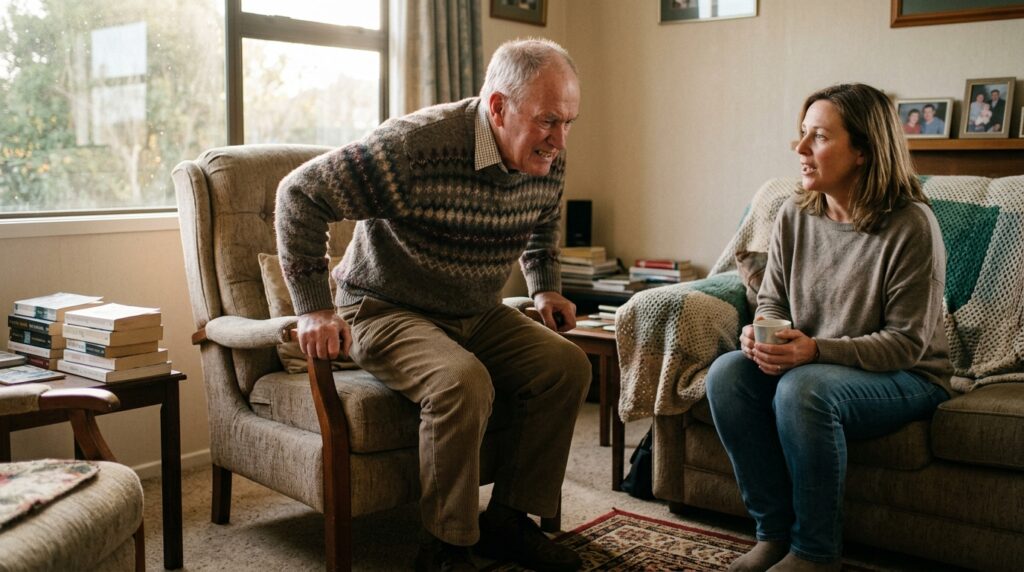
This is an easy change to miss. Dad pushes heavily through the armrests. He rocks forward several times before standing. He chooses higher chairs because low ones are becoming difficult to get out of.
Standing from a seated position uses strength, balance and coordination. If it is becoming noticeably harder, do not simply replace every chair with a higher one and forget about it.
Consider whether other movements have changed too.
- Can Dad still get out of bed comfortably?
- Can he get off the toilet without difficulty?
- Can he get in and out of the car?
One difficult movement may reveal a wider change in strength or mobility.
Worth checking:
If getting up from chairs has become harder, consider asking the GP whether a physiotherapy referral might be appropriate. A targeted strengthening programme may help improve the strength and movement needed to stand from a seated position.
2. His walking has changed
You may notice that Dad:
- Walks more slowly
- Takes shorter steps
- Shuffles
- Pauses more often
- Looks down at the ground while walking
- Reaches for walls or furniture
- Seems less steady when turning
- Needs more breaks.
The important thing is change from his usual walking pattern. A gradual difference may be easy to overlook when you see someone regularly. Adult children who live in another city sometimes notice it more clearly because several months may pass between visits.
If Dad’s walking has changed noticeably, particularly over a short period, it is worth raising with his GP or another appropriate health professional.
3. Stairs are quietly disappearing from his routine
Dad may not say, “I’m struggling with the stairs.”
Instead, he adapts. He leaves things downstairs rather than carrying them up. He may start sleeping in another room, stop using part of the garden because reaching it involves steps, or avoid visiting places where he knows there are stairs.
Adaptation can be sensible. But it can also hide the extent to which mobility is changing. Ask what has become harder rather than assuming a new routine is simply a preference.
4. Everyday journeys are getting shorter
Think about Dad’s normal radius of activity. Perhaps he used to walk around the block but now only goes to the letterbox.
He may drive to the supermarket because walking from home has become tiring. He may stop browsing the hardware store because there is nowhere convenient to sit. He may no longer walk around the garden in one go.
These changes matter because mobility affects more than movement around the house. It influences whether someone can remain connected to their community, hobbies, friends and normal routines.
For families across New Zealand:
If an older parent is going out less, consider whether the barrier is mobility itself or something practical, such as transport, confidence when walking outdoors, fatigue or not having someone to go with. Transport support or companionship on outings may help them stay connected to the shops, activities, friends and local routines that matter to them.
5. He is taking much longer to complete familiar tasks
Sometimes reduced mobility appears as time and effort, rather than an inability to do something.
Dad can still make lunch, but standing at the kitchen bench wears him out.
- He can shower independently, but needs a long rest afterwards.
- He can hang out the washing, but it takes much longer.
- He can shop, but carrying groceries from the car is becoming difficult.
Technically, he can still do everything. In practice, everyday life is taking much more energy. That difference matters.
6. He is avoiding activities he used to enjoy
A mobility change can become a lifestyle change before anyone notices. Gardening becomes “too much work”. Golf stops because “the weather hasn’t been good”.
The weekly walk with a friend gradually disappears. Trips into town become less frequent. Sometimes preferences genuinely change. But if several physical or social activities disappear around the same time, ask whether movement, pain, fatigue or confidence might be part of the reason.
Losing an activity can also mean losing some of the regular movement that previously helped maintain strength.
7. Dad is becoming cautious about movement
Mobility is partly physical and partly about confidence.
Someone may start saying:
- “I’ll stay here.”
- “You go without me.”
- “I don’t want to hold everyone up.”
- “It’s easier if you bring it to me.”
These comments can sound practical. But if they become common, Dad may be beginning to organise his life around avoiding difficult movement. That deserves attention even if he has not fallen.

Look at What Dad Has Stopped Doing
When families try to assess an older person’s mobility, the instinct is to focus on what they cannot do. There is a more revealing question: What has Dad stopped doing, without mentioning it?
The comparison below is not a clinical assessment. Instead, think of it as a prompt for observation. Look at how life looked a year ago, and how it looks now.
| Twelve months ago | Now | What it may suggest |
|---|---|---|
|
Walked to the local shops |
Drives, or asks someone else to go |
Walking stamina or confidence may have reduced |
|
Gardened for an afternoon |
Does one small task then stops |
Fatigue or pain may be affecting sustained physical activity |
|
Used both levels of the house |
Mostly stays downstairs |
Stairs may have become difficult or are being avoided |
|
Attended regular activities |
Goes out less; reasons are vague |
Movement difficulty may be affecting social participation |
|
Carried his own groceries |
Leaves heavier bags for someone else |
Upper body strength or grip may have changed |
|
Showered without thinking about it |
Plans showers around when someone is nearby |
Balance or confidence in the shower may have reduced |
|
Walked confidently outdoors |
Chooses only short, familiar routes |
Outdoor mobility or confidence may have changed |
When Should Mobility Changes Be Checked?
A noticeable change in mobility should not simply be labelled “old age”, particularly when it is new, worsening or affecting everyday life. Talk with a GP or appropriate healthcare professional if Dad’s movement has changed significantly or if there are other symptoms or health concerns.
Depending on the situation, further support may involve a physiotherapist, occupational therapist or another relevant health professional.
A physiotherapist may help with movement
A physiotherapist can assess areas such as movement, strength and balance and provide appropriate exercises or rehabilitation.
This can be particularly useful after illness, injury, surgery or a period of reduced activity.
An occupational therapist looks at everyday function
An occupational therapist can consider how Dad manages actual activities at home and whether equipment or changes to the environment could make them easier or safer.
That might include how he:
- Gets in and out of the shower
- Uses the kitchen
- Moves between rooms
- Gets in and out of bed
- Manages steps
- Completes everyday household activities.
Physiotherapy and occupational therapy have different roles, but both can contribute to maintaining independence. Home support does not replace either service. Practical assistance can instead work alongside clinical or rehabilitation recommendations.
Do not let “being careful” mean doing nothing
When movement becomes harder, the instinct in many families is protective: “Dad, sit down. I’ll do it.”
That response makes sense when there is an immediate safety concern. But doing everything for someone who can still participate may unintentionally remove opportunities for movement that help them stay active and involved.
Health NZ recommends regular physical activity for older people and notes that activity can be broken into shorter amounts across the day. Strength, balance and flexibility activities are specifically encouraged. ACC’s Live Stronger for Longer programme provides strength and balance resources for older New Zealanders.
The goal should be appropriate movement, rather than automatically doing less. Support can help Dad continue with the movements he can safely manage.
That might mean Dad continues making breakfast while someone helps with carrying the shopping. He keeps watering the garden but gets help with digging. He still walks to the local café but uses transport for longer journeys. A good support arrangement is built around what Dad can still do, not just around what he can no longer manage.
Mobility equipment: a tool, not a defeat
Families sometimes see a walking stick or frame as evidence that independence has been lost. It is more useful to think of it like glasses or hearing aids: a tool that may help someone function more safely and confidently, rather than a symbol of decline.
That said, the equipment needs to be right for the individual. Borrowing something from a relative or purchasing a frame without understanding what Dad actually needs is not necessarily helpful. Using unsuitable equipment or using it incorrectly may create additional risks. A physiotherapist or occupational therapist can advise on what is suitable, how it should be used and when it should be reviewed.
If equipment is already being used, it should remain in good working condition. Worn rubber tips, loose joints and an incorrect height are examples of issues worth checking.
The gap between fully independent and full-time care
There is an important space between “Dad is completely independent” and “Dad needs full-time care”. Many older people experiencing mobility changes may need some support without needing full-time care.
Dad may manage showering, dressing and making breakfast confidently while struggling with:
- Heavier household tasks such as vacuuming, gardening or carrying laundry
- Shopping and carrying groceries
- Transport to appointments, especially in wet weather or after tiring days
- Meal preparation after a physically demanding morning
- Maintaining social activities that require travel or sustained physical effort
A small amount of well-targeted practical support can take pressure off the activities that have become hard, without changing anything about the activities Dad can still do confidently. The aim is to support independence while providing help where it is genuinely needed.
🔗 MORE FROM OUR BLOG
- Repeated Falls in Older People
- How In-Home Physiotherapy Supports Recovery for Older Adults in New Zealand
- Moving Safely, Living Confidently: How Mobility Services Ltd and Home Carers Support Independence at Home
- The First 2 Weeks After Hospital Discharge Are Critical
- Moving Forward Together: How The Mobile Physio & Home Carers Support Recovery and Independence
Mobility support after illness or hospitalisation
Not every mobility change is a permanent decline. An older person who was previously independent can return home from hospital significantly weaker, more fatigued or less steady than their usual baseline, even after a relatively short admission.
Recovery from surgery, illness, injury or a period of bed rest can take longer than families expect, particularly when the person was already experiencing some mobility changes before the admission. During the first few weeks at home, finding the right balance of activity and rest can be important. Too much activity may be difficult or unsafe, while too little movement may make it harder to rebuild strength.
Practical support at home with meals, daily routines, personal care, companionship and transport can work alongside physiotherapy and occupational therapy recommendations rather than replacing them. Home Carers’ recovery and mobility support is designed to complement a clinical rehabilitation plan where one is in place.
A Simple Mobility Check for Families
If Dad seems to be slowing down, consider these questions:
- Has his walking changed noticeably?
- Is standing from chairs or getting out of bed harder?
- Has he stopped using stairs or certain parts of the house?
- Is he going out less because movement feels difficult?
- Are familiar activities taking much more effort?
- Has he stopped hobbies that involve movement?
- Is pain, fatigue, dizziness or breathlessness affecting what he does?
- Is he relying on furniture or other people when moving around?
- Has his confidence in moving changed?
- Is the family doing more physical tasks for him than six months ago?
The value of this checklist is not the number of “yes” answers. It is about noticing changes over time.
Is Dad Recovering at Home and Struggling More Than Expected?
Visit Home Carers New Zealand to arrange practical recovery support that works alongside any physiotherapy or rehabilitation programme already in place. Support can include meal preparation, daily routines, transport, mobility assistance and companionship during recovery. Home Carers helps older people across New Zealand recover at home while easing some of the practical pressure on families.
Whether Dad has recently been discharged from hospital or you’re supporting a slower recovery over time, our team can help you explore what level of support may be appropriate.
YOU CAN ALSO REACH US DIRECTLY
Frequently Asked Questions
Is it normal for older people to walk more slowly?
Some changes in movement, strength and endurance can occur with age. However, a noticeable change from someone's usual walking pattern, particularly when it affects everyday activities or develops quickly, is worth discussing with an appropriate healthcare professional.
What are early signs of mobility decline in an older person?
Signs can include slower walking, shorter steps, difficulty standing from a chair, avoiding stairs, needing more rest, reducing outings and giving up activities that require more movement.
How can an older person maintain mobility?
Regular physical activity can help maintain strength, balance and general function. Health New Zealand recommends older adults include aerobic, strengthening, flexibility and balance activities as appropriate to their abilities. Individual health conditions should be considered before starting new exercise programme.
Should Dad use a walking stick or walking frame?
Mobility aids can support safe movement when they are appropriate for the individual. A physiotherapist or occupational therapist can help determine what equipment is suitable and advise on correct use.
Can physiotherapy help an older person who is slowing down?
Depending on the reason for the mobility change, physiotherapy may help assess movement, strength and balance and provide an appropriate programme. It can be particularly relevant after injury, surgery, illness or reduced activity.
How can home care support someone with reduced mobility?
Practical home support can help with activities that have become physically demanding, such as shopping, meal preparation, household tasks, transport and daily routines. It can also work alongside a rehabilitation plan where appropriate.
Does reduced mobility mean Dad can no longer live independently?
Not necessarily. Mobility exists on a spectrum. Some older people remain independent with small changes, appropriate equipment or occasional support, while others need more regular assistance. The important question is how mobility changes are affecting everyday function.
What is available in New Zealand to help older people with strength and balance?
ACC's Live Stronger for Longer programme provides strength and balance resources for older New Zealanders, including community-based options. Health New Zealand also provides guidance about staying physically active in older age.