
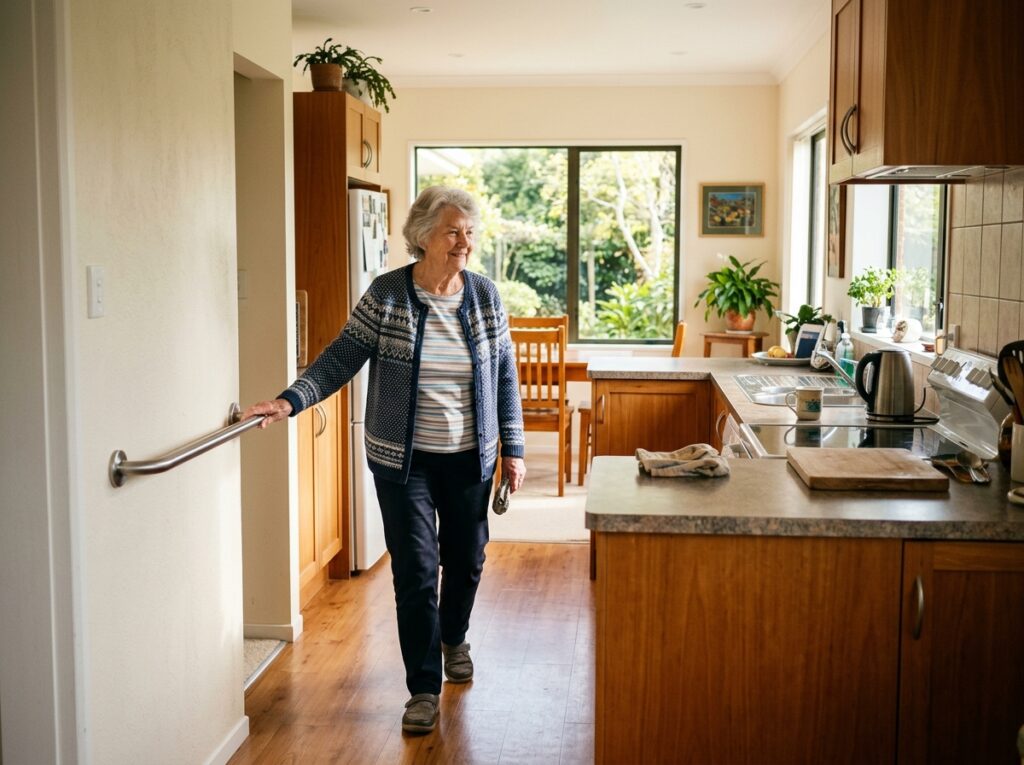
Mum still drives to the shops. She makes her own cup of tea. She insists she is perfectly fine living in the house she has known for decades.
But lately, there are small things that make the family wonder. The fridge looks emptier than it used to. A bill was paid twice. She stopped going to her weekly group. When nobody answered the phone one evening, it took several worried calls before someone finally reached her.
None of these things necessarily mean an older person can no longer live independently.
However, when several small changes start appearing together, it may be time to look more closely at how well day-to-day life is actually working.
✅ Quick Answer
An older person may still be safe living alone if they can manage everyday tasks, eat well, take medication correctly, move around, respond to emergencies and stay socially connected. The question is not simply whether Mum or Dad lives alone. It is whether their current health, abilities, home environment and support network still allow them to do so safely.
How Do You Know If an Older Parent Is Still Safe Living Alone?
Living alone safely is not about whether Mum can manage one particular task. It is about how well everyday life is working as a whole. Meals, medication, mobility, personal care, memory, household tasks and the ability to get help in an emergency all provide useful clues.
Rather than waiting for one major incident, families can look for small changes across these areas.
Here Are Ten Practical Areas Families Can Check:
1. Are they eating and drinking properly?
A parent can sound completely fine during a phone call while quietly struggling with meals. The question “Have you eaten?” rarely gives a complete picture.
When you visit, open the fridge. Is there fresh food available? Are groceries being used or are they going out of date? Has Mum stopped cooking meals she used to enjoy? Is there evidence of regular meals, or mostly snacks and biscuits?
Other signals to look for:
- Unexplained weight loss
- Regularly skipping meals or forgetting whether they have eaten
- Difficulty carrying groceries, opening containers or preparing ingredients
- Drinking very little during the day (older people often feel less thirsty)
- Finding that preparing meals for one now feels like “too much effort”
Health NZ notes that eating well helps older people maintain their energy, muscle strength, bone health and independence. The important question is not whether Mum can technically cook. It is whether she is eating and drinking well enough when nobody else is around.
Support option:
Meal preparation is one of the most common and practical starting points for home support. A few visits each week may make a meaningful difference without taking away from a parent’s independence.
2. Are medications being taken correctly?
Medication management is another area where problems can stay hidden. Unlike a fall, there is often no visible sign that something has gone wrong.
Check for:
- Doses being missed or taken twice
- Prescriptions running out unexpectedly
- Old medication accumulating in the cupboard
- Confusion about what each medicine is for
- Difficulty remembering when to take multiple medicines
This becomes particularly important when medication errors appear alongside memory changes, dizziness, falls or confusion. Rather than simply adding more reminders, it may be useful to discuss these changes with a pharmacist or GP.
Important:
Repeated medication mistakes in an older person should be raised with a healthcare professional rather than managed at home with pill organisers alone. Taking several medicines can sometimes contribute to issues such as dizziness or low blood pressure, so a medication review with a GP or pharmacist may be worthwhile.
3. Is personal care still being managed?
Changes here can be subtle, and older people sometimes try to hide them. Someone who has always taken pride in their appearance may start wearing the same clothes repeatedly. Showers become less frequent. Hair goes unwashed. Laundry accumulates.
Before assuming the issue is memory or motivation, ask what has actually become difficult. Often the answer is practical:
- Stepping into the shower feels unsafe without something to hold
- Buttons and fastenings are harder because of arthritis
- Standing long enough to get dressed is tiring
- Getting clothes in and out of the washing machine now hurts
Sometimes a small amount of practical assistance is enough to keep the rest of the person’s routine independent. A carer who helps with showering three times a week can provide support with that particular task while Mum continues managing the rest of her day in her own way.
4. Can they move around the home confidently?
Rather than looking only for falls, pay attention to how your parent moves around the home during everyday activities.
- Are they holding onto furniture as they walk?
- Do they hesitate before using stairs?
- Is standing from a low chair or sofa becoming a visible effort?
- Are they avoiding certain rooms or walking more slowly than before?
- Is getting in and out of bed becoming difficult?
- Are they going outside less, perhaps because walking has become harder?
These changes often develop so gradually that families may not immediately notice them. Health NZ identifies mobility problems, poor balance, previous falls and fear of falling among the factors associated with falls in older people.
A physiotherapist or occupational therapist can help identify what is contributing to mobility changes and what might make everyday movement safer. The aim is not to stop someone moving. It is to help them continue moving safely for as long as possible.
5. Is the house still being managed?
Sometimes the first signal that living alone is becoming harder is not a medical concern at all. It is a change in how the home is being managed.
Mail accumulates. Bins are not taken out. Laundry sits untouched. Food is left on benches. Cleaning standards change noticeably. The garden becomes increasingly unmanaged.
Importantly, look for a change from their usual standard, not an ideal standard of how a home “should” look. If Dad has never cared about dust, a dusty bookshelf tells you nothing. If Mum has always kept a tidy, organised home and now seems overwhelmed by everyday tasks, that change is meaningful.
The aim is to identify which tasks have become difficult, not to take everything over. Someone may still manage finances, cooking and personal care confidently while benefiting from a few hours of help with cleaning, laundry or shopping.
6. Are memory or judgement changes affecting daily life?
Occasionally forgetting a name or losing track of why you walked into a room can happen as people get older. On its own, this does not mean someone can no longer live safely at home.
Pay more attention when memory changes begin affecting everyday decisions and routines:
- Leaving appliances on or forgetting that food is cooking
- Repeatedly losing important items such as keys, a wallet or a phone
- Missing appointments or becoming confused about dates and times
- Getting lost on familiar routes
- Making unusual or uncharacteristic financial decisions
- Forgetting conversations that happened recently
- Struggling with tasks that were previously straightforward
The pattern matters as much as any single incident. Early assessment with a GP can help families understand what may be changing and start planning while the older person can still be actively involved in decisions about their own life.
Note:
Memory and cognitive changes can have many possible causes, including some that may be treatable. Medication effects, vitamin B12 deficiency, thyroid problems and infections are among the possibilities a healthcare professional may consider. A GP assessment is an important first step before drawing conclusions about what is changing and why.
7. Could they get help in an emergency?
This is one of the most important questions for anyone living alone, and one that families often don’t think through until something goes wrong.
If something happened at 2am, what would Mum actually do?
Consider different scenarios: a fall where she cannot reach the phone, a sudden illness, a power cut or a moment of confusion when she cannot remember who to call first.
Check whether your parent:
- Keeps a phone nearby at all times, including overnight
- Can use it confidently, including to call 111 under stress
- Has emergency contacts clearly visible, rather than only stored on a phone
- Has a trusted neighbour who could check on them
- Could unlock the home for emergency services if needed
- Has, or would consider, a personal medical alarm
Health NZ provides information about personal medical alarms for people who may need help in an emergency, including those at risk of falling. For someone living alone, having a clear way to call for help can provide an extra layer of safety.
8. Are they still connected with other people?
Living alone and being lonely are not the same thing. Some older people genuinely enjoy their own company and have active, satisfying lives with plenty of social connection. Others gradually become isolated without family realising, particularly when getting out and staying connected becomes more difficult.
Look for changes such as:
- Stopping regular activities or clubs without a clear reason
- Seeing friends or neighbours less often
- Rarely leaving the house for several days at a time
- Becoming reluctant to drive, making it harder to get out and see people
- Losing interest in hobbies or activities they previously enjoyed
- Becoming unusually withdrawn, flat or less engaged in conversation
The question is not "Does Mum live alone?" it is "Does Mum feel connected to other people?"
Regular companionship, whether it comes from family, community groups, neighbours or a regular carer, can help an older person stay socially connected and maintain a familiar routine.
9. What happens at night?
Daytime visits give families only a partial picture. Someone who appears confident and capable at lunchtime may be struggling at 11pm when they need the bathroom and the hallway is dark.
Ask specifically about night-time routines and safety:
- Getting to the bathroom safely, especially when waking suddenly
- Lighting on the route from the bedroom
- Dizziness when standing quickly at night
- Confusion about the time or disorientation after waking
- Anxiety about being alone overnight, even if they do not mention it directly
- Whether the phone or a medical alarm is within reach
Night-time difficulties can prompt families to consider whether additional support is needed overnight.
Someone may manage well during the day but find certain tasks more difficult to manage safely at night.
10. How much is the family already doing?
This is the check families most often overlook, partly because it requires honesty about their own role.
Mum may appear to be living independently. But consider what is actually happening behind the scenes:
- One daughter orders all the groceries online
- A son manages every bill and prescription
- A neighbour takes the rubbish out
- Someone calls every morning to remind Mum about medication
- A family member drives her to every appointment
- Another person visits several evenings a week to prepare dinner
There is nothing wrong with any of this. Family support can be exactly what allows an older person to remain at home safely, and it often comes naturally as needs gradually change.
But it is worth taking an honest look at how much support is already being provided. Ask:
If the family stopped doing these things for one week, what would actually happen?
That question often reveals more about someone’s actual level of independence than the fact that they live alone. It also helps families notice when the support they are providing has become difficult to sustain, and whether some consistent outside help could ease the pressure.
Look for patterns, not one imperfect day
Everyone forgets something occasionally. Everyone has an untidy week. Older people are allowed to make choices their adult children might not make for themselves. The aim is not to inspect Mum’s life looking for faults. It is to notice changes and patterns over time.
| What you notice | Likely signal | What it might suggest |
|---|---|---|
|
One forgotten meal |
Low concern |
Probably an unusual day. Keep an eye on whether it happens again. |
|
Regularly empty fridge, skipped meals |
Worth addressing |
Meal preparation or shopping may be becoming difficult |
|
One missed tablet |
Low concern |
Check what happened and monitor for a pattern |
|
Repeated medication errors or confusion |
Worth addressing |
Medication management needs a GP or pharmacist review |
|
One quiet weekend indoors |
Low concern |
Not concerning on its own |
|
Increasing withdrawal, fewer outings |
Worth addressing |
Social connection, mobility or wellbeing may need attention |
|
One messy room |
Low concern |
May mean very little |
|
Household tasks steadily accumulating |
Worth addressing |
Daily tasks may be becoming genuinely harder to manage |
|
Family occasionally helping with specific tasks |
Occasional support |
Occasional help may be all that is needed |
|
Family managing most daily tasks |
Review needed |
Occasional support |
A simple three-level assessment for families
After working through the 10 checks, you may find that your family’s situation broadly falls into one of these three areas.
Is Mum managing?
Daily life is generally working. She eats well, manages medication, moves safely, keeps up with personal and household tasks and is connected to people. The focus may simply be on maintaining health, staying active and having a clear emergency plan in place.
Is Mum managing, but only just?
Several tasks are becoming difficult, or family members are providing increasing levels of informal support. This may be a good time to introduce a small amount of structured help before things become more difficult. A few hours of support each week with meals, cleaning, personal care or companionship can ease some of the pressure on both the older person and their family.
Is Mum no longer managing safely alone?
Multiple concerns are present at the same time: medication mistakes, declining mobility, poor nutrition, confusion, difficulty with personal care or difficulty managing safely when alone. In this situation, it is important to involve appropriate healthcare professionals and have a structured conversation about what support may be needed next. This does not automatically mean moving into residential care. Depending on the person’s needs, additional support at home may still be an option.
Independence is not an all-or-nothing test. An older person does not become “dependent” because someone helps with the laundry twice a week. The right support can fill the gaps without taking over the things they can still manage themselves.
How to raise the subject without making Mum feel managed
If the 10 checks reveal genuine concerns, avoid opening with: “You can’t live alone anymore.” That can quickly turn a practical conversation into one about losing independence.
Start with a specific, concrete thing that has changed:
- “I noticed getting the groceries seems more tiring lately. Which part is becoming difficult?”
- “You mentioned you’re not as comfortable showering when nobody else is home. What would make that feel safer?”
- “I’ve noticed you haven’t been going to your group lately. Is everything alright?”
Then listen. The answer may be different from what you expected, and the solution may be simpler than you think. Sometimes one practical change is enough. Sometimes the conversation reveals that Mum has been struggling for longer than anyone realised, and finally talking about it can help everyone understand what support would actually be useful.
If your parent is reluctant to accept help, it may also help to involve a GP, nurse or other healthcare professional. Some older people may feel more comfortable discussing changes in their health or independence with a professional as part of a broader conversation about staying well at home.
Found Yourself Nodding Along to Several of These Checks?
Talk to Home Carers New Zealand about what you’ve noticed and what kind of support might help your parent continue living safely and confidently at home.
Whether support needs to start this week or you’re still planning ahead, Home Carers can help you understand the options. This might mean a few hours of home help, overnight care or full daily support.
Having the conversation early can give families and older people more time to understand the options and make decisions together.
YOU CAN ALSO REACH US DIRECTLY
Frequently Asked Questions
How do I check on an older parent who lives in another city or overseas?
A regular private carer can provide an extra set of eyes and ears for families who can't visit often. Regular visits allow the carer to become familiar with the older person’s usual routines and notice when something seems different.Video calls and regular check-ins can also help family members stay informed when they cannot be there in person.
Is it possible to set up home support without my parent knowing I'm concerned?
Support works best when the older person is involved in the conversation. However, families often find it helps to start with a specific practical need rather than presenting home care as a response to a wider concern. For example, help with meals, shopping or household tasks can be a gentle starting point. Involving the older person in decisions about who visits, when they come and what they help with can also make the arrangement feel more comfortable.
What's the difference between a NASC needs assessment and arranging private home care?
A NASC needs assessment helps determine whether someone is eligible for publicly funded support and what services may be appropriate. Private home care can generally be arranged directly without waiting for a NASC assessment. The hours, timing and type of support can be discussed directly with the provider, and some families use private care alongside publicly funded services.
How often should I be visiting to realistically assess how Mum is managing?
There's no universal rule, but seeing your parent at different times and during normal routines can give you a more complete picture than seeing them only during planned visits. Pay attention to changes in meals, medication, mobility, personal care, household tasks and social routines over time. If distance makes frequent visits impossible, a regular private carer can also provide consistent support and communicate relevant changes to the family, with the older person’s agreement.
Can I ask the GP to check in on my parent without making a separate appointment?
You can contact your parent’s GP practice to share concerns, although privacy rules may limit what the practice can discuss with you without your parent’s consent. If there are concerns about medication, falls, mobility or cognitive changes, arranging an appointment or assessment with the GP is usually more useful than relying on an informal check-in. The GP can then advise whether referrals or further assessments are appropriate.
At what point does home care stop being enough and residential care become necessary?
There's no single threshold. Some people can continue living at home with significant levels of support, while others may reach a point where their health, safety or care needs are difficult to manage safely at home. Factors can include the need for ongoing clinical care, significant safety concerns, the home environment and whether enough support can realistically be provided. A needs assessment and discussions with relevant healthcare professionals can help families understand the available options.
What should I do if there is a sudden change rather than a gradual one?
A sudden, noticeable change in cognition, mobility, behaviour or physical wellbeing in an older person should be taken seriously and may require prompt medical assessment. Sudden confusion or changes in function can have many possible causes, including infection, medication issues or an acute health event. If symptoms are severe or there is an immediate safety concern, call 111 or seek urgent medical care.
Can a carer help if the family disagrees about the level of support needed?
Family disagreements about care are very common, and a private provider is not a substitute for professional mediation or clinical assessment. However, an assessment from a GP, occupational therapist or NASC assessor may give the family clearer information about the older person’s needs. A short trial of practical support may also help the family understand what level of assistance is useful in day-to-day life.