
It often starts small. One sibling takes Mum to a GP appointment. Another picks up groceries. Someone starts calling Dad every evening because he has been a little unsteady lately. Then their needs increase.
There are prescriptions to collect, bills to manage, meals to organise and appointments to remember. Someone needs to check in after work. Another family member becomes the person everyone calls when something goes wrong.
Before long, one sibling may quietly be doing most of it. Sharing care does not mean dividing every task equally. Siblings may live in different cities, have different work schedules, financial circumstances or relationships with Mum or Dad. What matters is making the workload visible, realistic and sustainable.
✅ Quick Answer
Siblings can share the care of an ageing parent by listing what actually needs to be done, assigning clear responsibilities based on each person’s availability and strengths, agreeing who handles emergencies and reviewing the plan as needs change. Fair does not necessarily mean everyone doing the same tasks or spending the same number of hours.
Why Does Caring for a Parent So Often Fall to One Person?
Usually, nobody formally decides that one sibling will become the main family carer. It just happens. Perhaps one daughter lives closest. One sibling works from home. Someone is better at dealing with doctors. Another has always been the organised one.
Initially, this makes sense. The problem comes when temporary arrangements quietly become permanent. The sibling who took Mum to one appointment becomes responsible for every appointment. The person who started helping with groceries becomes responsible for meals as well. The sibling who lives nearby becomes the automatic emergency contact.
Meanwhile, other family members may genuinely believe everything is under control. This is partly because much of caring is invisible.
Start by making the invisible work visible
Before deciding who should do what, write down what is already happening. Not just personal care. Include everything, even the work of remembering and keeping track of what needs to happen next.
VISIBLE TASKS (EASIER TO NOTICE AND SHARE)
- GP and specialist appointments
- Prescription collection
- Grocery shopping
- Meal preparation
- In-person visits
- Transport
- Personal care
- Household maintenance
- Overnight supervision
INVISIBLE TASKS (OFTEN CARRIED BY ONE PERSON)
- Remembering that the prescription renews next Thursday
- Noticing Mum is running low on groceries
- Tracking the next specialist follow-up
- Knowing the plumber needs to come back
- Remembering the podiatry appointment
- Updating other family members
- Communicating with healthcare providers
- Researching what support is available
The mental load is still part of caring for someone, even when it doesn’t look like it from the outside. Any honest conversation about sharing responsibility has to include it.
Sharing Care Does Not Have to Mean 50/50
Families sometimes get stuck trying to make care perfectly equal. That may not be realistic. One sibling might live five minutes from Mum in Hamilton while another lives in Auckland. Another might be overseas. One sibling may have young children. Another works shifts. Someone may have more financial flexibility but less available time.
Instead of asking:
“Are we doing exactly the same amount?”
try asking:
“Is everyone contributing in a way that is realistic, and is anyone carrying more than they can sustain?”
A workable plan might look completely uneven on paper while still being fair.
For example:
- One sibling handles weekly visits
- Another manages finances remotely
- Another arranges appointments
- Professional support covers personal care and meals
- Everyone contributes to decisions.
The mental load is still part of caring for someone, even when it doesn’t look like it from the outside. Any honest conversation about sharing responsibility has to include it.
10 Responsibilities Families Can Divide
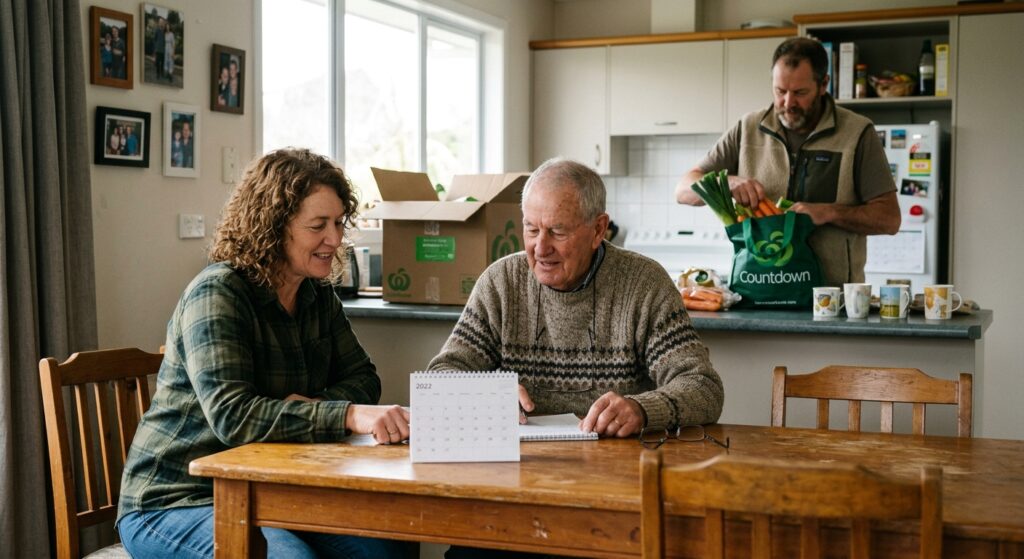
A practical way to share care is to break it into specific areas, assign a lead person and a backup, and be explicit about what each role actually involves. The ten areas below cover many of the responsibilities families manage for an ageing parent.
1. Appointments
One person takes responsibility for the appointment calendar — GP visits, specialist follow-ups, physiotherapy, podiatry, dental care and any assessments. This doesn’t mean attending every appointment. It means making sure appointments are booked, recorded and communicated to the rest of the family.
Someone else may handle transport. A third sibling may join by phone when an important decision is being discussed. Separating the coordination from the attendance makes it easier to share.
Common problem to avoid:
“I thought you were taking Dad.” “So did I.” This is what can happen when there is no named lead. Having one person responsible for the calendar, along with a backup, can prevent this kind of confusion.
2. Grocery shopping
Shopping can become surprisingly time-consuming. There may be groceries, prescriptions, toiletries and household items to organise. A sibling does not need to live nearby to manage this. Online grocery orders, click-and-collect and prescription delivery services mean remote siblings can genuinely contribute here. A local sibling collecting prescriptions while someone else manages the weekly order is a realistic split.
3. Finances and paperwork
Household bills, insurance, service invoices, regular payments and relevant applications can create a significant amount of administration. If Mum or Dad wants or needs help with these tasks, one person could take the lead. This requires clear boundaries: the older person’s financial privacy, decision-making rights and wishes should be respected throughout. Where a sibling is expected to make financial decisions on a parent’s behalf, appropriate legal arrangements may be needed.
Avoid:
Multiple siblings independently paying, changing or cancelling things without communicating. This can create errors, distress for the older person, and significant tension between family members.
4. Meals
Food support doesn’t mean one sibling has to cook every meal.
Start by understanding what Mum or Dad can still manage independently, then fill the specific gaps. One family’s workable arrangement might be: Mum prepares breakfast herself, one sibling organises the grocery order, a support person prepares several lunches during the week and the family has dinner together on Sunday.
The important questions are whether there is enough food available, whether meals are actually being eaten and whether preparing food is becoming difficult.
5. Regular check-ins
Without a plan, one sibling may call three times a day while another assumes someone else has checked in. Decide what a check-in actually means. It could be a phone call, a video call, an in-person visit or a medication check. Then create a simple weekly schedule.
This makes gaps visible and helps avoid both too many calls and days when everyone assumes someone else has checked in.
Example weekly schedule:
- Monday: Sarah calls
- Tuesday: James visits
- Wednesday: Professional support visit
- Thursday: Sarah video calls
- Friday: James calls
- Weekend: Family visit or rotation
6. Transport
When a parent stops driving or drives less, transport can quietly become a major source of family time and coordination. Trips include medical appointments, shopping, social activities, family events and pharmacy visits.
Try to avoid transport defaulting to whoever answers the phone first. Some journeys may be suitable for community transport, taxis or professional support. This can leave more family time for outings that matter, rather than every visit becoming another practical errand.
Worth noting:
Transport should not be organised only for medical appointments. Staying connected to the community, activities and friends matters for wellbeing. A parent who gets driven to the GP but nowhere else has transport support for healthcare, but may still struggle to stay socially connected.
7. Personal care
Personal care is different from picking up groceries. Help with showering, dressing, toileting or other intimate tasks can affect both the older person’s dignity and their relationship with family members.
Some parents are comfortable receiving this help from an adult child. Others are not, and some adult children may not feel comfortable providing it either. Both responses are understandable.
The question should not be “which sibling should do this?” It should be: “What arrangement best protects Mum or Dad’s dignity while providing the support they need?”
Professional home support may be an appropriate option, particularly when the family wants to keep intimate personal care separate from their relationship with Mum or Dad.
8. Overnight support
Overnight care is one of the hardest responsibilities for families to share on a regular basis, particularly when siblings are also working full-time. Someone may need overnight support because of mobility difficulties, dementia-related confusion, anxiety, recovery after illness or difficulty responding safely to an emergency when alone.
Rotating overnight stays may work temporarily. It can become difficult to sustain over months, especially when the following day still involves work and family commitments. If the need for overnight support becomes regular, it may be time to revisit the overall care plan rather than simply adding more nights to the family rotation.
9. Emergency contact
Every family care plan needs a clear answer to one question: who gets called first?
Name a primary contact and a backup. Make sure all relevant people, including the GP, support providers and trusted neighbours, know who these people are and how to reach them.
If Mum lives in Queenstown while her children are in Wellington and Christchurch, proximity doesn’t automatically determine who should coordinate an emergency. The person best placed to coordinate what needs to happen, whether physically near or not, may be the better person to hold this role.
10. Professional support coordination
Professional support should be treated as part of the care plan, not as evidence that the family has failed.
There are tasks family members may genuinely want to keep, such as Sunday lunch, a favourite outing or attending an important medical appointment together. Those moments can easily be crowded out when every visit involves cleaning, shopping, cooking and organising medication.
Professional support can help with some of the practical workload so that family members have more time and energy to simply be sons, daughters and siblings.
Have One Person Coordinate, Without Making Them Do Everything
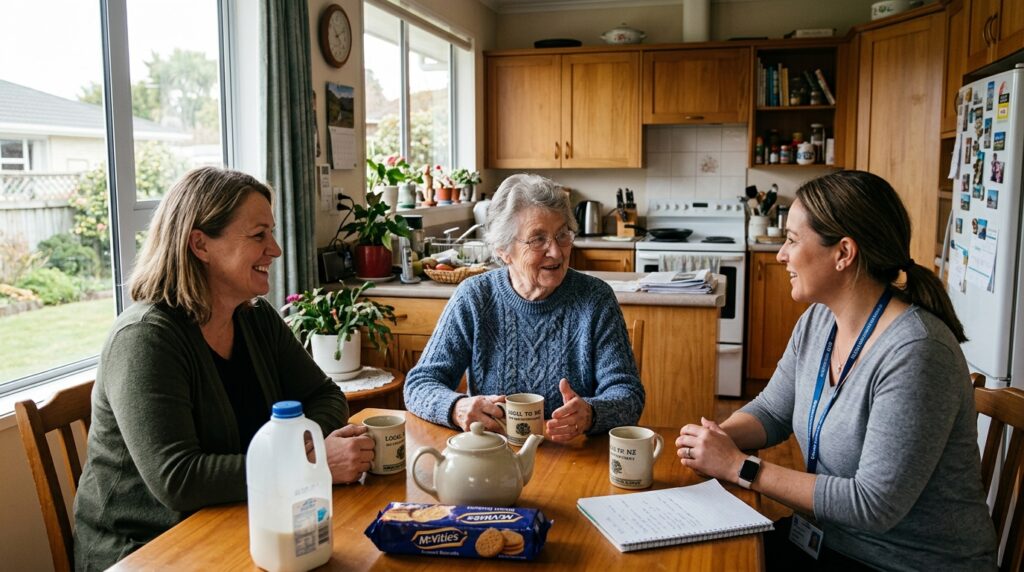
It helps to have one person acting as the main coordinator: keeping the family calendar updated, making sure everyone knows about changes and being the main communication point for external providers such as the GP, pharmacy, support workers and specialists.
Think of them as the person who keeps the pieces connected, not the person who holds every piece.
This becomes particularly valuable when several services are involved. A clear coordination point can reduce duplicated effort, help prevent information being lost between people and reduce the chance of Mum or Dad receiving several calls from family members who have each heard something slightly different.
Coordinator vs. carer:
These are different roles. The coordinator holds information and manages communication. They do not necessarily provide hands-on care. Treating coordination and hands-on care as the same job can leave one family member carrying far more than everyone realises.
Keep Family Communication Simple But Consistent
Family care doesn’t need a complex management system. A shared calendar, a family group chat, or a simple shared document is often enough. The important thing is keeping one central place where essential information lives:
- Upcoming appointments and who is handling each
- Medication changes and any health updates
- Who is visiting and when
- Shopping needed
- Professional support schedule and any changes
- Upcoming family absences — who won’t be available and when
Distinguish between updates and decisions. “Mum had a good lunch today” is an update. “We think Mum now needs someone every morning” is a decision that warrants a proper family conversation — and, importantly, Mum’s input where she is able to give it.
Keep Mum or Dad in the conversation
A family care plan must not become a plan about Mum or Dad that everyone discusses without them. Even with the best intentions, this can leave an older person feeling that decisions are being made for them rather than with them.
Wherever possible and appropriate, ask:
- “What would make things easier for you?”
- “Which things would you like to keep doing yourself?”
- “Who are you comfortable having help with this?”
- “What would you rather have someone outside the family help with?”
- “What matters most to you about staying at home?”
Families may be focused on efficiency and safety. Parents are often focused on privacy, independence and identity. Both are legitimate. A good plan considers safety while allowing Mum or Dad to keep as much choice and control as possible.
What If one Sibling Lives Far Away?
Distance doesn’t automatically mean someone cannot contribute meaningfully. A sibling in Auckland can coordinate support for a parent in Dunedin. Someone overseas can manage online grocery orders, organise appointments, handle family updates, research available services and arrange professional support without being physically present.
Meanwhile, the local sibling can focus on tasks that genuinely require physical presence. This can help reduceresentment, because being nearby should not automatically translate into being responsible for everything.
For families across New Zealand:
Home Carers supports families coordinating care from other cities or overseas. A support provider who visits regularly can provide a consistent local presence for families who cannot be there in person and, where appropriate, share relevant updates with family members wherever they are.
What If One Sibling Is Doing Much More Than Everyone Else?
Talk about it before resentment becomes the main family conversation. Use specific tasks rather than accusations.
Instead of:
“You never help with Mum.”
try:
“At the moment I’m doing her groceries, appointments, three evening visits and all the calls from the GP. I can’t keep doing all four. Which part can you take over?”
That gives the other person something concrete to respond to. Also recognise that siblings may have genuine limits. Not everyone can provide hands-on care. The solution may therefore involve redistributing some responsibilities within the family and using outside support for others.
Watch for the Mental Load, Not Just the Hours
Two siblings can spend the same number of hours on Mum and still carry very different loads. One may spend two hours visiting. The other spends two hours arranging appointments, speaking with providers, remembering prescriptions, answering Mum’s calls, checking bills and planning next week’s support schedule.
Both are care. Both take time and energy. Only one is easy to see.
When families review the workload, the mental load including the planning, coordinating and constant awarenessmust be part of the conversation. This less visible work can become exhausting, particularly when it falls mainly to one person.
When Family Support Is No Longer Enough on Its Own
There is a difference between “the family is involved in Mum’s care” and “the family must personally provide every hour of Mum’s care.” Those are not the same thing. Expecting family involvement to mean providing all of the care themselves can place enormous pressure on family carers.
As needs increase, the challenge may shift from “which sibling covers Tuesday?” to “how do we coordinate a reliable system?”
Professional support can take responsibility for specific parts of that system while the family remains closely involved in decisions, communication and spending meaningful time together.
This can give families more time to be present with the person they care about. A daughter who spends every Saturday doing three loads of washing and cleaning the bathroom has less time to simply sit, talk or have lunch with her mother. If practical support covers some of those jobs, their time together can feel more like family time again.
🔗 MORE FROM OUR BLOG
Looking for Extra Support at Home?
Visit Home Carers New Zealand to talk through how professional support can fill the specific gaps
in your family’s plan, ease the pressure on the sibling who is currently doing the most and give everyone more space to stay connected with Mum or Dad.
Home Carers supports families across New Zealand with everything from targeted weekly help to regular daily or overnight support.
Whether you’re building a plan from scratch or realising the current one isn’t working, our team can help you understand what support might be useful and where it could fit into your family’s existing care plan.
YOU CAN ALSO REACH US DIRECTLY
Frequently Asked Questions
How should siblings divide care for an older parents?
Start by listing all current responsibilities, including appointments, meals, shopping, finances, check-ins, transport and emergencies. Divide them according to availability, location and strengths rather than trying to make every sibling do exactly the same amount.
What if one sibling does most of the caregiving?
Make the workload visible and discuss specific tasks that can be reassigned. If other siblings cannot provide hands-on care, they may be able to manage administrative tasks, contribute remotely or help organise professional support.
How can siblings share care when they live in different cities?
Remote siblings can manage appointments, online shopping, family communication, research, agreed financial administration and regular phone calls. Local family members can focus on tasks that require physical presence.
Should one sibling be the main contact for Mum or Dad's care?
Having one main coordinator can simplify communication, particularly when multiple family members and providers are involved. However, coordinating should not mean that person becomes responsible for every care task.
How can families avoid arguments about caring for ageing parents?
Clear responsibilities can help. Keep a shared care plan, discuss changes before they become urgent and focus conversations on specific tasks and the parent's current needs rather than who has historically done more.
When should a family consider professional home support?
Professional support may be useful when care needs are becoming difficult to cover reliably, one family member is overloaded, personal or overnight care is needed, family members live far away or the parent's needs are becoming more complex.
Is respite care only for families who are already burnt out?
No. Respite can be used proactively. Planned support can give family carers regular time away from care responsibilitiesand help make the overall arrangement more sustainable before exhaustion becomes severe.
Does using professional care mean the family is less involved?
No. Professional support can cover practical or specialised parts of the care plan while family members remain involved in decisions, communication, companionship and the parts of the relationship that matter most to them.