
When families in Christchurch and Tauranga start planning aged care, the choice often boils down to two paths:
- Move into a retirement village or rest home and pay an upfront capital sum plus weekly fees, then an exit deduction later.
- Stay at home and pay only for the hours of in-home care actually used.
Both can be right — but the total cost over 5 years can look radically different. This guide arms families with a practical, apples-to-apples way to compare, without guesswork or surprises.

First, Understand the Key Mechanisms (So You Don’t Compare Apples to Pineapples)
- Retirement villages use an “occupation right” model (often a licence to occupy). You don’t own the unit; you purchase the right to live in it under an ORA (Occupation Right Agreement). That’s standard in NZ and is why villages can charge an exit fee later (more on that below). (Village Guide NZ, Companies Office)
- Most villages deduct a Deferred Management Fee (DMF) when you leave, commonly 20–30% of your original capital sum; it usually accrues over ~2–5 years and is retained by the operator when your agreement ends. (Village Guide NZ, Hurunui District Council)
- Residential/rest-home care may be partially funded for eligible people through the Residential Care Subsidy (means/asset-tested and paid to the provider). You must complete a needs assessment first. (Govt.nz, Work and Income)
- Home care has no entry or exit fee — you simply pay for the hours you use. Some hours can be offset by public funding such as Carer Support or support pathways identified via NASC. (Health Information and Services, Govt.nz, Disability Support Services)
The 5-Year Lens: A Simple Framework You Can Fill in with Your Own Quotes
Think of this as your DIY calculator. Use the items below to tally 5-year total cost for each pathway, then compare.
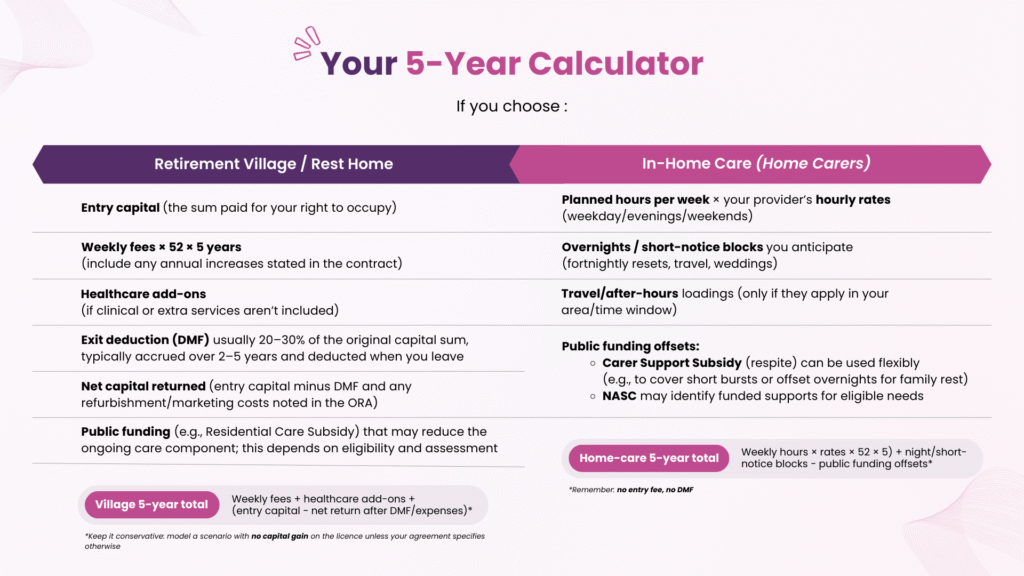
A Fair Comparison Needs Real Life, Not Brochure Promises
To keep costs honest and the comparison fair, use specific care windows instead of fuzzy “we’ll see” arrangements:
- Mornings for showering, dressing, and a safe start
- Wellness Checks mid-day for meds/meal prompts
- Companionship to keep spirits — and mobility — up
- Evening settle (meal, lock-up, toileting)
- Overnights only if night-time needs require it (wandering, high falls risk)
You’ll often spend less by booking predictable windows than relying on ad-hoc call-outs.
The “Balanced” Home-care Mix many Families Trial First
Here’s a 4–6 week pattern an independent expert might suggest to test at home:
- Morning Support x 3/week — safe starts and personal care
- Wellness Checks x 2/week — meds, meals, hydration, a quick mobility circuit
- Companionship x 1/week — a cuppa and a walk keeps mood and strength up
- Overnight Care x 2 nights/month — the reset that lets family truly sleep
Fine-tune from there: some families add an evening visit and drop a morning, others keep mornings and add one extra wellness check. The point is control — you dial care up or down without moving house or losing capital.
When the Village/Rest-home Path May Still Be Right
- High clinical needs (24/7 nursing, complex wound care, advanced dementia with behaviours of concern).
- Extended family absence (e.g., months overseas).
- Personal preference for an amenity-rich community with onsite staff around the clock.
If this is you, compare villages carefully: DMF rate and accrual period, what weekly fees do and don’t include, and any refurbishment/marketing charges on exit can materially change the net return. (Typical DMF ranges 20–30%, often accrued over 2–5 years).
When Home Care Often Wins On Both Cost and Wellbeing
- Your parent is happiest in familiar surroundings (routine, neighbours, pets).
- You want pay-as-you-go flexibility (increase hours after surgery, scale back when stable).
- You prefer no entry fee and no exit penalty (no capital tied up, no DMF).
- Dementia is present but responds well to routine and continuity at home.
Families frequently find that a predictable in-home pattern (mornings + wellness + targeted overnights) costs far less than they expected, while dramatically reducing stress.
How Public Funding Fits Into the 5-Year Picture
1. Carer Support Subsidy
Carer Support Subsidy exists to give full-time family carers a break. It can offset the cost of replacing the care a family member usually provides — helpful for respite blocks or overnights that protect the carer’s health.
2. A Needs Assessment (NASC)
A needs assessment (NASC) is required for many government-funded supports. It’s worth organising this early so you understand what may be available, even if you start privately for speed.
3. Residential Care Subsidy
If you’re exploring long-term residential care, the Residential Care Subsidy information explains eligibility and how payments are made directly to rest homes/hospitals.
A Quick Reality Check for Christchurch & Tauranga
- Christchurch: Scheduling consistent time windows and matching nearby carers keeps travel predictable; many families start with mornings + wellness and add an overnight during busy weeks.
- Tauranga: Popular for short-notice respite around family travel; households often use targeted overnights paired with lighter weekday support.

Two-Track Trial: Test Before You Commit
A retirement village can be the right lifestyle choice — but the DMF and weekly fees make the 5-year total very different from the headline “buy-in”. With home care, there’s no entry fee and no exit penalty; you pay for the hours you use, dial support up or down, and keep Mum or Dad in the place they already call home.
If you’re on the fence, run a two-track trial:
- A 4–6 week at-home pattern (mornings + wellness + targeted overnights), and
- A short hosted stay (if that’s your preference).
Compare costs, sleep, mood, and hospital visits. Let real life decide. Contact us to discuss a personalised plan.