
Hourly pricing suits families who need a small, flexible number of hours per week and want to scale up or down easily. Package pricing suits families who need a consistent, higher level of support — such as dementia care, overnight supervision, or 24/7 care — where a bundled weekly rate is simpler to plan around and budget for. Most families in Christchurch and Tauranga start on an hourly basis and move to a package once their loved one's needs become more predictable.
If you’ve already decided that home care is the right direction for your family, you’ve done the hardest part. The next decision is more practical, but it still causes a lot of hesitation: how should you actually pay for it? Most providers, including Home Carers, offer two different pricing structures — hourly rates and weekly care packages — and the right choice depends less on what sounds cheaper and more on what matches the rhythm of support your parent actually needs.
This guide walks through how each pricing model works in practice, what’s typically included, where the hidden trade-offs lie, and how families across Christchurch and Tauranga are choosing between them. We’ll also run through real worked examples so you can see the numbers applied to your own situation, not just generic ranges.
Understanding Hourly Rates and Care Packages
Before comparing costs, it helps to understand how hourly pricing and care packages work in practice because each model suits a different type of support need.
How Hourly Pricing Actually Works
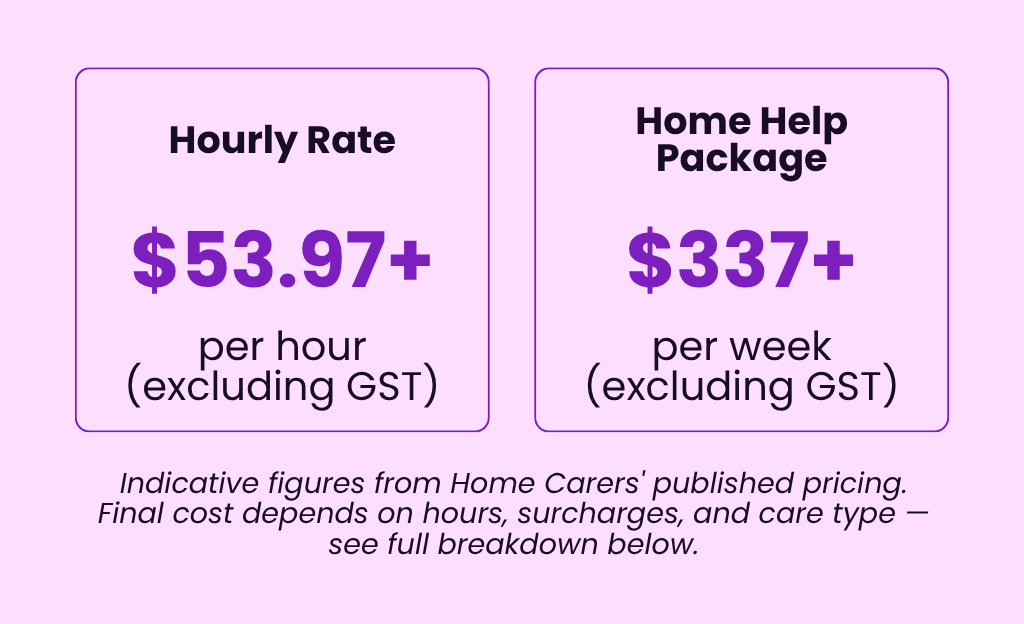
Hourly pricing is the simplest model to understand: you pay for the time a carer is actively in your home, and nothing more. Home Carers’ published rate starts from $53.97 + GST per hour, with most families beginning at three to six hours a week. There’s a three-hour minimum visit length, which exists to ensure carers aren’t travelling across Christchurch or Tauranga for a 45-minute job that barely covers their time.
One reason families choose hourly pricing is its flexibility. If your mum only needs help with showering, light meal preparation, and a weekly grocery run, you’re not paying for support she doesn’t use. If her needs increase — say, after a fall or a hospital stay — you simply add hours rather than renegotiating a contract.
What Affects the Hourly Rate
- Time of week. Weekend hours (from 5pm Friday to 7am Monday) carry a 15% surcharge, and public holidays carry a 20% surcharge.
- Notice period. Emergency care arranged within two days attracts a 50% surcharge, reflecting the cost of mobilising a carer at short notice.
- Travel. Mileage may apply for travel to and from your loved one’s home, capped at 15km each way, plus any travel undertaken during a visit (for appointments or outings), charged at the IRD rate.
- Type of support. Straightforward companionship or household help sits at the lower end of the range; dementia-related supervision or post-hospital recovery support typically costs more per hour due to the skill and attentiveness required.

How Weekly Care Packages Work
A package bundles a set number of hours, and sometimes a defined scope of support, into one weekly rate. Rather than tallying hours invoice by invoice, you know roughly what a typical week will cost, which many families find easier to plan around — particularly when a parent is in a more settled, ongoing stage of needing help.
Home Carers’ current packages provide a useful snapshot of the options available:
⚠️ Home Carers’ Package Tiers (excluding GST)
- Home Help Package — from $337 per week, for companionship and day-to-day household support
- Overnight Support Package — from $349 per week, covering 9pm–7am reassurance and response
- Dementia Support Package — from $539 per week, providing supervision suited to memory-related needs
- Post-Hospital Support Package — from $599 per week, supporting recovery routines after a hospital stay
- 24/7 Care Package — from $1,297 per week, for continuous around-the-clock support
Packages tend to suit situations that are less likely to change week to week — ongoing dementia supervision, for example, rarely scales down the way a recovery period after surgery might. Knowing the weekly figure in advance also makes it considerably easier to budget for the months ahead, particularly for families coordinating costs between siblings.
Hourly Rates vs Care Packages: A Side-by-Side Comparison
The table below compares the two pricing structures across the factors that matter most to families.
| Factor | Hourly rate | Weekly package |
|---|---|---|
|
Best suited to |
Light, occasional, or changeable support needs |
Consistent, higher-level, or specialist support needs |
|
Budgeting predictability |
Lower — varies with hours used |
Higher — known weekly figure |
|
Flexibility to scale up/down |
High — add or reduce hours anytime |
Moderate — packages can be adjusted, but less granular |
|
Typical starting point |
$53.97+ per hour, ex GST |
$337+ per week, ex GST (Home Help tier) |
|
Minimum commitment |
3-hour minimum per visit |
Set weekly scope, reviewed as needs change |
|
Good fit for |
Companionship, errands, occasional respite |
Dementia care, overnight supervision, 24/7 care, post-hospital recovery |
|
Surcharges still apply |
Yes — weekends, holidays, emergency callouts |
Yes — surcharges sit on top of the package rate |
The right pricing model isn’t necessarily about which option appears cheaper on paper — it’s about which one best matches how often your parent’s needs actually change.
A Worked Example: 12 Hours a Week, Two Ways
Numbers make this easier to picture than percentages alone. Here’s how a fairly typical scenario — a parent needing roughly 12 hours of support a week, split across companionship and some dementia-related supervision — might look under each model. These are indicative figures only, based on Home Carers’ published rates, and your actual quote will depend on your specific care plan.
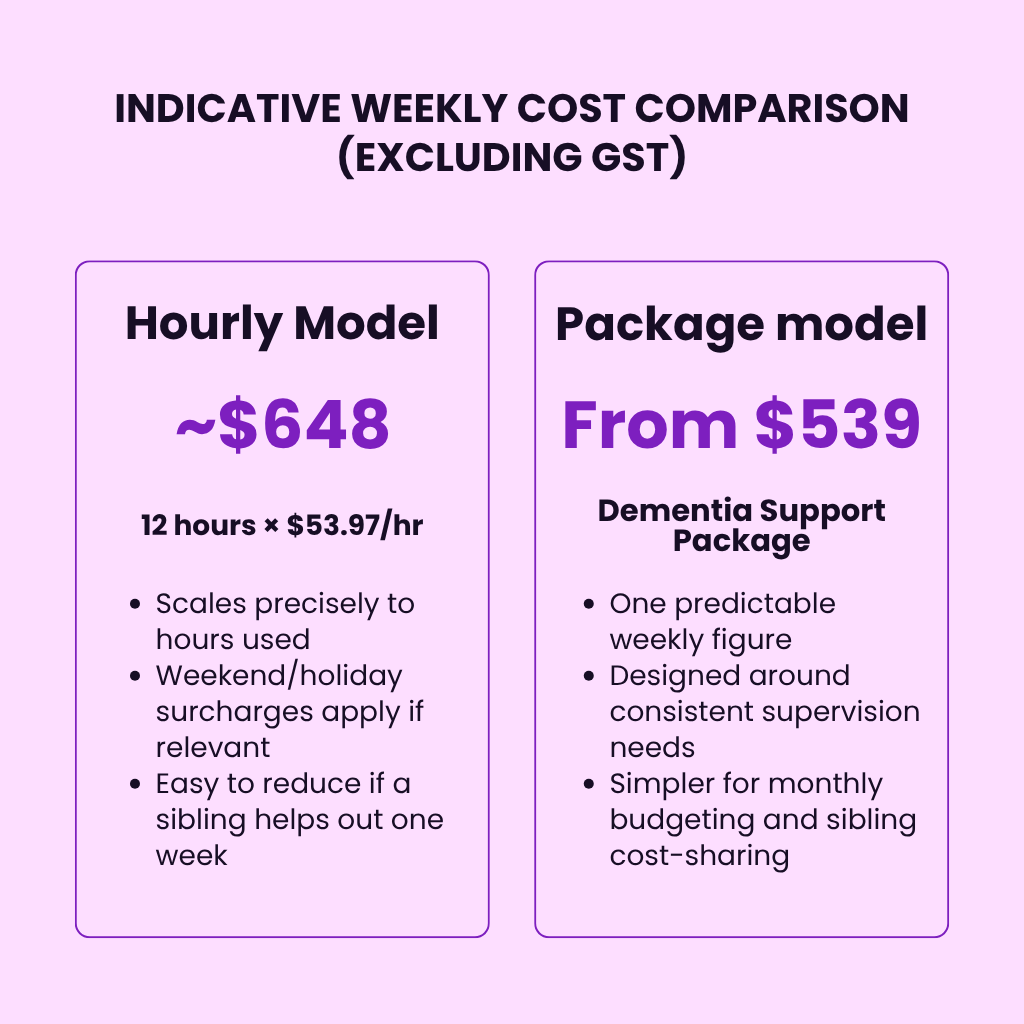
To estimate a monthly figure from any weekly rate, multiply by 4.33 (the average number of weeks in a month). A $539 weekly package, for example, works out to roughly $2,334 per month, excluding GST and any applicable surcharges.
When Families Typically Move from Hourly to a Package
There’s rarely a hard rule for this. However, a few patterns show up often:
- Hours have crept up steadily over a few months and now sit consistently above 10–12 a week.
- A diagnosis (most commonly dementia) introduces a need for supervision rather than occasional help.
- A hospital discharge requires structured, near-daily recovery support for a defined period.
- Overnight reassurance becomes necessary, meaning ad hoc hourly visits no longer make practical sense.
- The family wants one predictable number to plan around, rather than a fluctuating fortnightly invoice.
None of this needs to be decided in isolation. A good provider will talk through your parent’s current routine and flag honestly whether hourly or package pricing is the better starting point — and will tell you plainly if your needs don’t yet justify a package.
What Else Affects the Final Cost?
Here are some common additional costs and how Home Carers structures them:
| Item | Typical structure |
|---|---|
|
Setup / onboarding fee |
$197 + GST, charged once for new clients |
|
In-home assessment |
Free with Home Carers (normally valued at $279) |
|
Weekend surcharge |
15% on hours between 5pm Friday and 7am Monday |
|
Public holiday surcharge |
20% on official NZ public holidays |
|
Emergency care surcharge |
50% for support arranged within two days |
|
Travel / mileage |
IRD mileage rate, capped at 15km each way for travel to the visit |
Transparency on these line items matters more than the headline rate. A provider advertising a lower hourly figure but adding undisclosed minimum-hour rules or rigid contract terms can end up costing more in practice than one with a slightly higher but fully disclosed rate.
Funding May Be Available Alongside Either Pricing Model
It’s worth knowing that private hourly or package fees aren’t always the whole picture. Families recovering from an injury may have part of their support funded through ACC. In addition, full-time family carers may be eligible for the Carer Support Subsidy administered by Health New Zealand, which provides a needs-assessed allocation that can be used flexibly rather than being tied to a fixed daily rate. A Needs Assessment and Service Coordination (NASC) assessment is usually the starting point for accessing this kind of support.
For an independent look at how private home support pricing is typically structured across the sector, Eldernet’s guide to private home support costs is a useful starting reference, separate from any individual provider’s own figures.
How to Decide Which Pricing Model Fits Your Family
⚠️ A Simple Way to Think It Through
- If your parent’s needs change week to week, start with hourly and review after a month.
- If you’re already certain about ongoing dementia, overnight, or 24/7 needs, ask about the relevant package from day one.
- If siblings are splitting costs, a fixed weekly package is usually easier to divide fairly.
- If you’re recovering from a hospital stay with an uncertain timeline, hourly often makes more sense until the picture is clearer.
- Regardless of which option you choose, ask for the full rate card — including surcharges — before committing to either model.
There’s no need to get this exactly right on the first attempt. Most families adjust their pricing structure at least once as their parent’s needs become clearer, and a responsive provider should make that adjustment simple rather than something that requires renegotiating from scratch.

🔗 EXTERNAL RESOURCES FOR NZ FAMILIES
Ready to Find the Right Pricing Fit for Your Family?
Visit Home Carers New Zealand to explore flexible, transparent pricing options for home care across Christchurch and Tauranga. Whether you’re leaning toward hourly support or a weekly package for dementia, overnight, or 24/7 care, our team can help you compare the real costs side by side and choose the option that fits your family’s budget and routine. Visit our pricing page to see current rates, or get in touch and we’ll talk it through together.
YOU CAN ALSO REACH US DIRECTLY
Frequently Asked Questions
Can I switch from hourly to a package later, or vice versa?
Yes. With Home Carers, there are no lock-in contracts, so families can move between an hourly arrangement and a weekly package as needs change, with 7 days' notice requested where possible to allow for smooth scheduling.
Do package rates include weekend and public holiday surcharges?
No — surcharges (15% for weekends, 20% for public holidays) sit on top of either pricing model. A package rate reflects the base scope of support, not the timing surcharges that may apply within it.
Is GST included in the advertised rates?
Home Carers' published hourly and package rates are quoted exclusive of GST. It's worth confirming with any provider whether their advertised figure is GST-inclusive or exclusive, as this can meaningfully change the comparison.
If I only need a few hours a week, is a package still worth considering?
Generally, no. Packages are built around consistent, higher-hour needs such as dementia supervision or overnight care. For a handful of hours a week, the hourly model is usually more cost-effective and better suited to light or occasional support.
Does a package guarantee the same carer every visit?
Continuity of care is a priority either way, though it isn't a strict guarantee under either pricing model. Providers who prioritise matching the same one or two carers to a family, rather than rotating through a large roster, tend to deliver more consistent continuity regardless of whether you're on hourly or package pricing.
How quickly can a package be set up if my parent's needs increase suddenly?
Home Carers can usually arrange support quickly, though requests for care within two days are treated as emergency requests and carry a surcharge. Setting up a package slightly ahead of an anticipated need, such as before a planned hospital discharge, avoids this extra cost.