
When families in Christchurch or Tauranga start looking at in-home care, costs can feel like alphabet soup: hourly rates, packages, public-holiday loadings, travel fees, assessments, subsidies… and, if you’re considering a retirement village, there’s that mysterious DMF. This quick but thorough guide is your seven-minute “sanity check” so you can avoid overpaying, compare providers fairly, and choose the best fit for Mum or Dad.
Bookmark this if you’re comparing home care cost NZ options, respite care NZ, or weighing retirement village costs.
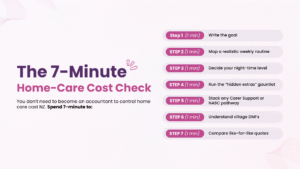
Step 1 (1 Minute): Define the Real Goal (So You Only Buy What You Need)
Before you ask for quotes, decide what outcome you actually want over the next 4–6 weeks. Common goals:
- “I need two guilt-free mornings to rest” (respite)
- “Mum’s just home from hospital; we need short-term support” (post-discharge)
- “We need a safety net while I’m at work” (wellness/monitoring)
- “I need a proper night’s sleep” (overnight care)
Naming the goal stops you buying “everything” and focuses spend where it matters.
Step 2 (1 Minute): Map A Realistic Weekly Routine (Your Hour-builder)
Open your calendar and build a first pass:
- Mornings that need hands-on help (showering, dressing, breakfast)
- Medication and meal prompts (lunchtime wellness check)
- One companion visit for mood and movement (walks, cuppa, crossword)
- A night-time plan (none / evening settle / partial night / full overnight)
This gives you a weekly hours estimate before you see any prices. You’ll typically spend less by booking predictable windows than ad-hoc calls.
Step 3 (1 Minute): Decide Your Night-time Level (The Quiet Budget Killer)
Nights can chew budgets if you guess. Use this quick decision tree:
- Evening visit if it’s about set-up (meal, meds, settle, lock-up).
- Partial night if there are 1–2 predictable wake-ups.
- Full overnight if there’s wandering, high falls risk, or frequent toileting.
Tip: Pairing evening + morning often reduces the need for a full overnight while keeping everyone safe and rested.
Step 4 (1 Minute): Run the “Hidden Extras” Gauntlet (Ask These 10)
This is where families accidentally overpay. When you request a quote, ask for plain-English, itemised answers to:
- Standard weekday hourly rate
- After-hours rate (evenings)
- Weekend and public-holiday rates
- Minimum visit length / minimum weekly hours
- Travel fees (e.g., per-km after a threshold)
- Cancellation / rescheduling rules
- Short-notice or emergency fees
- Package rules (what’s included/excluded)
- Carer matching (same carer where possible?)
- In-home assessment cost (and whether it’s credited)
You’re not being fussy — you’re avoiding bill shock later.
Step 5 (1 Minute): Check What Funding You Could Stack (It All Adds Up)
There are 2 common public pathways you should know about:
1. Carer Support Subsidy (via Health NZ | Te Whatu Ora)
A contribution toward respite so family carers can take a break; you choose how to use allocated hours (e.g., a few hours a day or overnights, depending on the allocation).
2. Needs Assessment and Service Coordination (NASC)
An assessment pathway that looks at needs (not income) and can connect eligible people to funded supports (in-home, day programmes, or residential respite, depending on the case).
 Helpful resources:
If you’re comparing home care with rest home/residential care, see the NZ Government’s overview of paying for residential care and the related Residential Care Subsidy criteria.
Tip: Even when public support is pending, starting with a light private plan (e.g., mornings + a mid-week wellness check) keeps things safe without overspending.
Step 6 (1 Minute): If You’re Considering A Retirement Village (Factor the DMF)
Retirement village marketing often emphasises community and amenities — but don’t skip the total cost of ownership over 3–5 years.
Most villages charge a Deferred Management Fee (DMF), typically 20–30% of the original capital sum, usually accruing over 2–5 years and deducted when you leave (or your estate does).
Helpful resources:
- What is the Deferred Management Fee (DMF)? – Eldernet
- The Costs of Living in a Retirement Village – Village Guide
By contrast, home care has no entry fee and no exit fee; you pay only for the hours you use. If you’re torn, run a “two-track” trial: 4–6 weeks at home with predictable support vs a short trial stay elsewhere — then compare real life, not just brochures.
Step 7 (1 Minute): Compare Quotes Fairly (Apples to Apples)
Use this quick framework to evaluate in-home care cost across providers:
Hours & windows |
Rate sets |
One-offs |
Net total |
| Weekday mornings: X hours | Standard weekday: $rate | In-home assessment: $… | Base (H × relevant rates) + Extras (travel, etc.) − Any credits/discounts = Comparable weekly cost |
| Mid-day wellness prompts: Y hours | After-hours / weekend / public holiday: $rate | Onboarding/setup (if any): $… | |
| Companion time: Z hours | Packages (if any): $package total | ||
| Evenings / nights: … | Travel (per-km after threshold): $… | ||
| Total base hours: H |
Repeat with Provider B the same way. If one quote is “bundled” and one is itemised, ask for an itemised version so you can compare line-by-line. Transparency wins.
3 Smart Starter Mixes (Copy/Paste to Your Plan)
1. Light & safe (great for Christchurch & Tauranga suburbs)
Morning Support × 3/wk + Wellness Checks × 2/wk.
Outcome: safer routines, meds/meals on track, predictable spend.
2. Balanced break for family carers
Morning Support × 3/wk + one companion visit + Overnight Care (1 night/fortnight).
Outcome: meaningful respite without a full weekly overhaul.
3. Post-discharge stabiliser
Hospital to Home package for 1–2 weeks, tapering to Morning Support + Wellness Checks.
Outcome: avoids the “cliff” after hospital and reduces readmission risk while costs settle into a routine.
Christchurch & Tauranga: Local Notes That Reduce Spend

- Plan for traffic/time windows. A consistent slot (e.g., “Mon/Wed/Fri between 8–10am”) helps rostering and can cut avoidable travel add-ons.
- Cluster visits. If Mum needs meal prompts and light housekeeping, cluster tasks in one visit rather than two separate pop-ins.
- Be specific. Share mobility notes, medication times, and preferred routines up-front — it lets your provider right-size the hours (not over-spec them).
Not Sure Where to Start?
Try a two-week pilot with Morning Support + Wellness Checks, add an Overnight Care reset if needed, or ask about Hospital to Home for post-surgery recovery. A good provider will right-size hours (not upsell them) and give you itemised, plain-English pricing.
Explore our services:
Or Contact us today to discuss a personalised plan.