
Families often ask: “What will dementia care at home really cost — and how do we keep it sustainable?”
The short answer: costs depend more on routine, timing, and night-time needs than anything else. The good news is that with a calm, predictable plan, most households can control spend and get better outcomes for Mum or Dad — without leaving home.
This guide explains the key cost drivers, shows three sample weekly budgets, and outlines funding pathways NZ families use to reduce out-of-pocket costs. It’s written for families in Christchurch and Tauranga who want practical, transparent answers.
What Actually Drives The Cost of In-home Dementia Care?

1. Care Windows & Tasks
Morning personal care (showering, dressing, breakfast) is hands-on and usually the anchor. Light Wellness Checks at mid-day are shorter (meds, meals, hydration, a quick mobility circuit).
2. Night-time Needs
Evening settling, wandering, toileting, or sleep reversal can change the plan. Sometimes an evening visit (set-up, prompts, lock-up) is enough; other times you’ll need partial night help or a full overnight.
3. Frequency & Continuity
A predictable schedule (e.g., 3× mornings + 2× Wellness Checks) often costs less overall than ad-hoc call-outs. Matching the same carers improves pace, trust and efficiency.
4. Short-notice / After-hours / Public Holidays
These time bands are usually priced differently; plan your routine in regular windows when possible.
5. Travel Distance
Keeping the schedule consistent and pairing tasks in the same visit helps avoid extra trips.
The “Calm-Day” Routine (A Practical Template)

A steady day reduces confusion, risks, and unplanned spend.
- Morning Support (60–90 mins): unhurried personal care, breakfast, light tidy.
- Wellness Check (20–45 mins): medication prompts, hydration, a short walk or strength-balance routine.
- Companionship (60–120 mins): a cuppa, photos, music, simple tasks — things that feel like life, not care.
- Evening Settle (30–60 mins): meal, reminders, night-time set-up, lock-up.
Night-time Decision Guide
- Choose Evening Only if night risks are low and routine is steady.
- Choose Partial Night if there are 1–2 predictable wake-ups.
- Choose Overnight if there’s wandering/high falls risk, frequent toileting, or carer exhaustion.
Most households start light (evening + morning) and trial an overnight once a fortnight to protect the family carer’s sleep — then adjust.
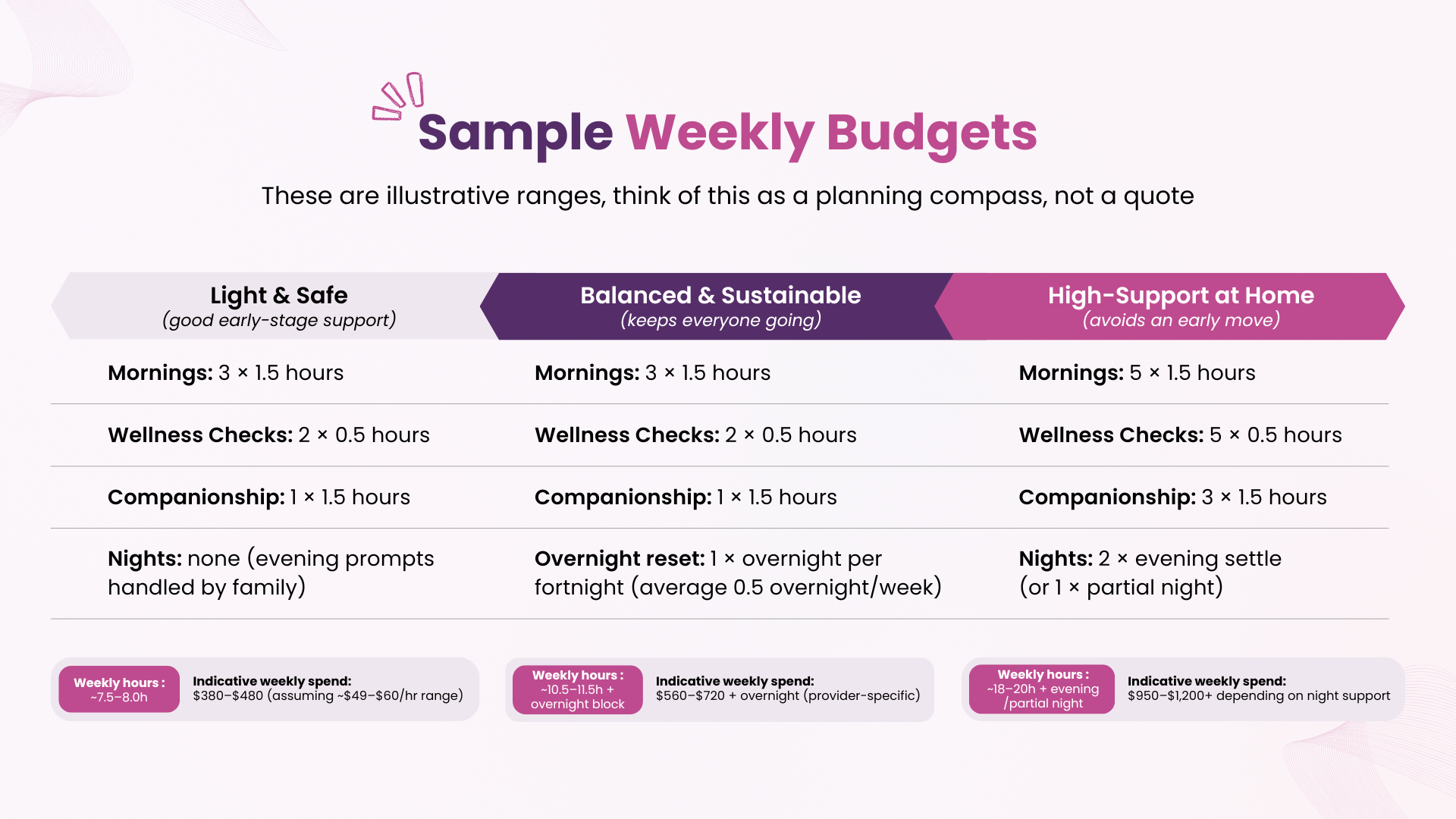
Sample Weekly Budgets (Realistic Scenarios)
These are illustrative ranges to show how hours combine. Actual figures vary by provider, region, time bands, and add-ons. Think of this as a planning compass, not a quote.
Funding: Stacking Support to Reduce Out-of-Pocket Costs
1. Carer Support Subsidy (Health NZ | Te Whatu Ora)
Designed so family carers can take a break. Allocated hours can be used flexibly — e.g., to offset respite blocks or overnights that protect the carer’s health.
2. Needs Assessment & Service Coordination (NASC)
Looks at level of need (not income) and may connect eligible people with funded supports (in-home, day programmes, or residential respite). Start early; you can top up privately while waiting.
Tip: Even when funding is pending, start with a light private plan (e.g., mornings + one mid-week Wellness Check). It stabilises routines now and is easy to scale.
When to Dial Hours Up (or Down)
1. Increase Support if you notice:
- Missed meds, weight loss, dehydration or UTIs
- Night wandering or repeated falls
- Carer exhaustion, sleep disruption, or rising frustration
- Return from hospital or a new diagnosis
2.Reduce or Re-shape hours when:
- The routine is stable for 4–6 weeks
- Tasks are consistently finished early
- Family/whānau can re-join for one care window (e.g., weekend companion slot)
Why Many Families Choose Home Carers for Dementia Care at Home
- Continuity: matched carers wherever possible — familiarity reduces anxiety.
- Dementia-aware approach: gentle cueing, calm pacing, and predictable routines.
- Flexible bookings: start light, trial an overnight, scale smoothly.
- Local teams: Christchurch & Tauranga coverage with realistic time windows.
- Post-hospital support: Hospital to Home helps avoid the “cliff” after discharge.
- Plain-English pricing: itemised, transparent, and easy to adjust.
- Fast setup: short-notice options where availability allows.
- Family-centred communication: notes, preferences, and updates kept simple.
Keeping Dementia Care Affordable at Home
Dementia care at home becomes more affordable and sustainable when you commit to a calm, repeatable day: mornings for safe starts, short Wellness Checks to keep meds and meals on track, companionship to protect mood and mobility — and targeted night support only when it’s truly needed.aw
 Explore our services:
Start small, review each fortnight, and shape the plan to fit your parent — not the other way round. If you’re in Christchurch or Tauranga, the team at Home Carers can help you right-size the first month and keep costs predictable.
Contact us today to discuss a personalised plan.