
Both retirement villages and in-home care can be good options — but they suit very different situations. A retirement village offers community and safety in a new environment, while in-home care allows an older person to remain in their own home with flexible, personalised support tailored to their needs. For many families in New Zealand, in-home care is the option that preserves the most independence, familiarity, and choice — particularly when arranged before a crisis occurs.
Why Families Often Feel Rushed Into This Decision
When a parent starts to need more support, families are rarely given the luxury of time. A fall, a hospital admission, a quiet phone call where Mum sounds confused — and suddenly there’s a conversation that nobody planned for, happening faster than anyone expected.
One of the first questions that comes up is: “Should we look at a retirement village, or can they stay at home with some extra help?”
It’s an important question — and one worth taking the time to answer properly. This guide helps families in Christchurch, Tauranga, and across New Zealand think it through clearly, without pressure, and with a real understanding of what each option actually involves.
In-Home Care
Support comes to your parent in their own home. Flexible hours, familiar surroundings, personalised carers.
Retirement Village
Purpose-built community living with varying levels of support. A new environment with shared facilities.
This is one of the most important things families don’t talk about enough. Many New Zealand families do not make major care decisions calmly, over weeks of research — they’re made in the aftermath of a health event, when emotions are high and someone else (a hospital discharge coordinator, a GP receptionist, a well-meaning neighbour) suggests that “it might be time to look at a village.”
For this reason, understanding why families feel rushed can help you slow down and make a better decision.
- A hospital discharge creates urgency.
- Fear from a single incident.
- Caregiver burnout has reached a breaking point.
- Waitlists and availability create artificial urgency.
- No one has explained the in-home alternative properly.
Taking a moment to understand the options isn’t being slow — it’s being responsible. Most care decisions made calmly and with good information can lead to better outcomes for everyone.
Understanding the Two Options: What They Actually Involve
A retirement village is a residential community specifically designed for older people, typically those aged 70 and above. They range from independent living apartments (where residents manage their own lives with minimal support) through to care suites with nurse-supervised medical support.
Most villages in New Zealand operate under an Occupation Right Agreement (ORA) — a legal structure that’s quite different from a standard property purchase. Residents pay an entry contribution (often a significant portion of their home sale), a weekly fee, and a deferred management fee when they leave. The NZ government’s retirement village information explains the legal obligations in detail.
Importantly, villages vary significantly in what they include. Some offer very little day-to-day care and are closer to a gated community for active older adults. Others include meal services, wellness programmes, and access to rest home or hospital-level care on the same site.
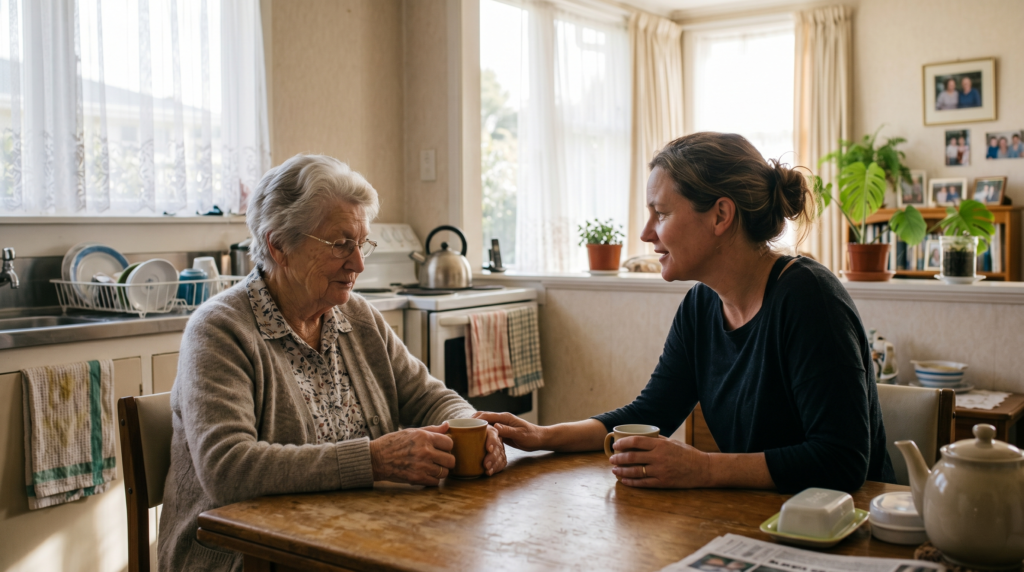
In-home care — sometimes called home support or domiciliary care — means that professional carers come to the older person’s existing home to provide whatever level of support is needed. This can range from a few hours of assistance per week through to 24/7 live-in or rotating carer arrangements.
Private in-home care (like that provided by Home Carers NZ) goes well beyond basic home help. Services can include:
- Dementia support and overnight supervision
- Post-hospital recovery care
- Respite care for family carers
- Mobility and rehabilitation support
- Medication reminders and wellness checks
- Companionship and social connection
- Coordination with allied health providers (physio, OT, podiatry)
In contrast, the key distinction from a retirement village is that the person stays in their own home. — with their own furniture, their own garden, their own routines, and their own sense of belonging — while the care comes to them.
Retirement Village vs In-Home Care: Side-by-Side Comparison
This table covers the key practical differences most families want to understand before choosing between the two options.
| Consideration | Retirement Village | In-Home Care (Private) |
|---|---|---|
|
Entry Cost |
Large upfront contribution (often $300K–$700K+) via ORA |
✓ No entry fee — pay for care hours only |
|
Living Environment |
New purpose-built community, leaving existing home |
✓ Stays in own home and community |
|
Weekly Fees |
Ongoing village fee ($120–$250/week + extras) |
~ Hourly or package rates — scales to need |
|
Contract Flexibility |
Long-term ORA, exit fees on departure |
✓ Flexible — start, pause, or change support anytime |
|
Level of Care Available |
Varies widely by village type |
✓ From light help to 24/7 complex dementia care |
|
Social Connection |
✓ On-site community, activities, events |
Depends on how support is designed |
|
Dementia Suitability |
✗ Relocating can increase confusion and disorientation |
✓ Familiar home reduces disorientation |
|
Reversibility |
✗ Difficult and costly to undo once the home is sold |
✓ Fully reversible — no lock-in |
How Do the Two Options Actually Compare?
To help families see the full picture clearly, the table below breaks down the most important practical differences side by side.
Retirement Village
✅ Genuine Advantages
- Built-in social community and activities
- Physical security and safe environment
- Reduces family worry about falls or emergencies
- Good option for those who are socially isolated
- Scalable care if the village has higher-level care suites
⚠️ Real Limitations
- Large upfront financial commitment and exit fees
- Requires leaving home, which many people deeply resist
- New environment can worsen confusion in dementia
- Not easily reversible once the home is sold
- Care levels vary widely — not all villages offer high support
In-Home Care
✅ Genuine Advantages
- The person stays in their own home and familiar routine
- No large financial entry commitment
- Fully flexible — hours and services adjust to changing needs
- Can start within days, not weeks
- Particularly beneficial for those with dementia
⚠️ Real Limitations
- Social isolation can remain an issue if not addressed
- The home itself may need modifications for safety
- At a 24/7 level, support may involve a higher weekly cost.
- Quality varies between providers — consistency of carers matters
In many cases, families who explore in-home care seriously are surprised by how much is possible. Moreover, staying at home isn't about doing less — it's about bringing the right level of support to the right place. As a result, many families find this option better suited to their parent's actual needs and preferences.
When a Retirement Village Might Be the Right Choice
Being honest means acknowledging when a retirement village genuinely is the better option. It may be worth serious consideration when:
- The older person actively wants the social environment and has expressed this clearly — rather than simply agreeing when asked.
- They are relatively well and independent, and the village offers a lifestyle upgrade rather than a response to increased care needs.
- Isolation is a significant concern and the home environment is genuinely contributing to loneliness.
- The family has fully understood the ORA financial terms and is satisfied with them.
- The village chosen has appropriate care levels for the future, not just the present.
⚠️ IMPORTANT NOTE
Many families choose a retirement village because they weren’t aware of what was possible at home, or because they felt they had no other option at the time. If the move hasn’t happened yet, it’s worth speaking with an in-home care provider first — even briefly — to understand the full picture. The decision is much easier to reverse now than later.
When In-Home Care Is Likely the Better Option
In-home care is typically the more suitable choice when:
- The older person wants to stay at home and says so clearly
- They have dementia — familiar environments significantly reduce disorientation and distress
- The family wants to explore options before making a permanent financial commitment
- Support is needed urgently and there’s no time for a village placement process
- The person only needs temporary support — recovery from surgery, illness, or a period of increased need
- A family carer needs relief but the person doesn’t need to move permanently

A Special Note: Dementia and the Move to a New Environment
If your parent has been diagnosed with dementia — or you’re noticing signs of cognitive decline — this section is particularly important.
Dementia affects a person’s ability to form new spatial memories and adapt to unfamiliar surroundings. Moving into a retirement village, even a well-staffed one, often increases confusion, anxiety, and distress — at least in the short term, and sometimes permanently. What can appear like a safe and structured environment to an observer can feel deeply disorienting to someone with dementia.
💡 RESEARCH CONTEXT
According to Dementia New Zealand, familiar environments — including the smells, sounds, and layout of a person’s own home — can significantly reduce anxiety and behavioural symptoms in those living with dementia. Specialist in-home dementia support aims to preserve these environmental anchors while adding the safety and supervision that families need.
This doesn’t mean a retirement village is never suitable for someone with dementia — some have excellent memory care units. But it does mean the default assumption that “moving somewhere safe” is better than staying home should be questioned carefully. Specialist dementia care at home is a well-established, evidence-supported option.
Questions to Ask Before Making Any Decision
Whether you’re leaning toward a retirement village or in-home care, these questions are worth working through as a family:
- Have you asked your parent — clearly and without pressure — where they would prefer to live?
- Are you making this decision in response to a crisis, or with time to research properly?
- Have you spoken with a private in-home care provider to understand what’s possible at home?
- If considering a village: have you read and understood the ORA, including exit fees?
- Does your parent have dementia? If so, have you considered how a move might affect them?
- Is caregiver burnout a factor — and could respite care address this without a permanent move?
- What does the person’s GP recommend, and have you discussed options with them?
- What will your parent’s support needs look like in two years — and will this option still work?
🔗 EXTERNAL RESOURCES FOR NZ FAMILIES
Talk to a Home Care Advisor Before You Decide
YOU CAN ALSO REACH US DIRECTLY
Frequently Asked Questions
Is in-home care a realistic alternative to a retirement village in New Zealand?
Yes, for many families it is — and in some situations it's clearly the better choice. Modern private in-home care in New Zealand covers a wide range of needs, from light household assistance through to 24/7 dementia supervision and complex recovery support. The key difference is that the person stays in their own home rather than moving to a new environment. For those with dementia in particular, remaining at home in familiar surroundings often leads to better wellbeing outcomes than transitioning to a new setting.
How quickly can in-home care be arranged compared to a retirement village?
In-home care can often be arranged within 24–48 hours for urgent situations. Retirement village placements involve a legal process (signing an Occupation Right Agreement), a waiting period, and often the sale of a property — which can take weeks or months. If a family is in a crisis situation following a hospital discharge or fall, in-home care is typically the only option that can respond in time.
What is an Occupation Right Agreement (ORA) and what should families know about it?
An ORA is the legal contract used by most retirement villages in New Zealand instead of a standard property purchase. The resident pays a large contribution for the right to occupy a unit, but does not own the property outright.
When they leave — whether voluntarily or after passing away — a deferred management fee (typically 20–30% of the entry price) is deducted from the refund. It is essential that families seek independent legal advice before signing an ORA. The NZ government's retirement village information page provides a useful overview of the legal obligations involved.
Can someone with dementia stay safely at home with in-home care?
In many cases, yes — and specialist in-home dementia care is specifically designed to make this possible. Support can include overnight supervision, morning and evening routines, medication reminders, companionship, and coordination with GP and allied health services. Familiar surroundings are actually beneficial for most people with dementia, as they reduce disorientation and anxiety. The right level of support depends on the stage of dementia and the individual's circumstances. Speaking with a specialist provider is the best place to start.
What does in-home care cost in Christchurch and Tauranga?
Private in-home care is typically charged on an hourly or packaged basis, with rates varying depending on the level of care, hours required, and whether overnight or 24/7 support is needed. Unlike retirement villages, there is no large upfront financial commitment — families pay for the care provided. Home Carers NZ offers transparent pricing; you can visit the pricing page on the website for current rate information, or call 0800 227 686 to discuss a care plan suited to your situation.
Is there government funding available for in-home care in NZ?
Yes — families can access publicly funded home-based support through a Needs Assessment and Service Coordination (NASC) process, usually accessed via your GP. However, waitlists for publicly funded support can be significant. Private in-home care, like that provided by Home Carers NZ, can be arranged immediately without a NASC assessment, with costs paid privately. Some families use private care as a bridge while waiting for public funding to be allocated.
What is respite care and could it help our family?
Respite care is short-term, professional support that gives family carers a planned break. It can be arranged for a few hours, overnight, or for longer periods. For families where caregiver exhaustion is a factor in considering a retirement village move, respite care often provides the relief needed without requiring any permanent decision. It is available quickly through Home Carers NZ and can be the option that allows families to keep a parent at home for longer — without anyone burning out in the process.
What if we choose home care now but need more support later?
One of the strongest advantages of in-home care is that it scales. A care plan that starts with a few hours of weekly support can expand over time to include daily visits, overnight care, and eventually 24/7 rotating carer arrangements — all without the person ever leaving their home. This flexibility means families can respond to changing needs without making irreversible decisions early. It also allows a retirement village to remain an option for the future if circumstances genuinely change.