
Overnight dementia support in Tauranga provides trained in-home carers who supervise and assist people with dementia through the night — reducing wandering risks, managing sundowning behaviour, and giving family members the rest they need to continue caring.
WHAT THIS ARTICLE COVERS:
- Why nights are especially difficult with dementia
- What overnight dementia support looks like at home in Tauranga
- How it compares to rest home placement
- Funding pathways including NASC and private options
- When it’s time to consider 24/7 around-the-clock support
- How to arrange support quickly if you need help now
Why Nights Are So Hard With Dementia
Anyone who has cared for a parent with dementia will know that night-time often brings its own set of challenges. The house goes quiet, and yet the person they’re caring for may become more agitated, confused, or restless than at any point during the day.
This is partly explained by sundowning — a pattern common in moderate to advanced dementia where confusion and distress tend to worsen in the late afternoon and evening. Disorientation about time and place can lead to wandering, repeated questioning, calling out, or attempts to leave the home. For families in Tauranga managing this alone, it can quickly become unsustainable.
60%
2–4am
1 in 3
Sleep deprivation doesn’t just exhaust carers — it affects decision-making, emotional resilience, and ultimately the quality of care they can provide. Families in Tauranga often reach out when they’ve reached a point where they simply cannot continue without support through the night.
What Overnight Dementia Support Looks Like at Home
Overnight support for dementia in Tauranga is not simply someone “checking in” before bed. When provided properly, it means having a trained, trusted carer present in the home through the night — awake and attentive — or available to respond immediately if needed.
What a trained overnight carer typically does:
- Assists with evening routines — personal care, medication reminders, settling into bed
- Monitors for wandering and gently redirects the person if they become unsettled
- Responds calmly to night-time confusion or distress without escalating agitation
- Assists with bathroom trips during the night to reduce fall risk
- Maintains a reassuring presence if the person wakes disoriented
- Prepares a light breakfast and morning medications to begin the day well
- Communicates with the family each morning on how the night went
The goal isn't just safety overnight — it's continuity of care from a familiar face who understands the person's patterns, preferences, and what settles them when the night becomes difficult.
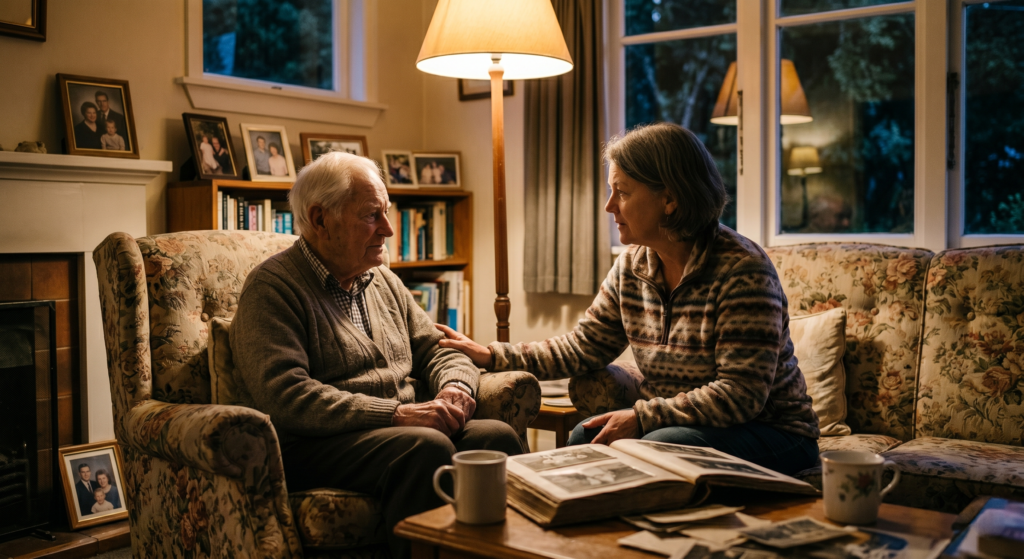
Overnight Support vs. Rest Home Admission: What Families Need to Know
One of the most common concerns families in Tauranga bring to these conversations is whether overnight difficulties with dementia mean their loved one needs to move into residential care. In many cases, the answer is no — not yet, and perhaps not at all.
| Factor | Overnight Support at Home | Rest Home / Memory Care |
|---|---|---|
|
Familiar environment |
✓ Stays at home |
New surroundings |
|
Continuity of carer |
✓ Same faces |
Rotating shifts |
|
Family involvement |
✓ Full control |
Visiting hours |
|
Flexibility |
✓ Adjust anytime |
Fixed care plans |
|
Independence preserved |
✓ Higher |
Limited |
|
Setup speed |
✓ Often within days |
Waitlists apply |
Research consistently shows that people with dementia who remain in familiar surroundings — with consistent carers and routines — tend to experience less anxiety and cognitive decline than those placed in new environments. Remaining at home is not just a preference; it often genuinely supports wellbeing.
When Overnight Support Becomes 24/7 Care
For some families in Tauranga, overnight support is just the beginning. As dementia progresses, daytime supervision also becomes essential — not as a failure of family caregiving, but as a natural response to changing needs.
Around-the-clock support at home means a coordinated team of carers rotating through day and night shifts, maintaining continuity, communicating with the family, and ensuring no single carer is ever overstretched. This is a very different experience from residential care — it’s personalised, relationship-based, and built entirely around the individual’s routines, preferences, and comfort.
Signs it may be time to consider 24/7 support:
- Your parent cannot safely be left alone during the day as well as at night
- Falls or injury risks have become frequent regardless of time of day
- Family carers are exhausted, unwell, or burning out
- Dementia-related behaviour has become unpredictable and difficult to manage
- Hospital discharge has created an urgent care gap
Funding Pathways: What Families in Tauranga Need to Know
Cost is a real and reasonable concern. Many families don’t realise there are multiple pathways to accessing support — and that private support can often begin far faster than waiting for publicly funded options.
| Funding Type | How to Access | Availability |
|---|---|---|
|
NASC Assessment |
Via general practitioner referral to Needs Assessment Service Coordination |
Waitlists apply |
|
Subsidised home care |
Following NASC assessment and criteria |
Limited hours |
|
Private funding |
Direct arrangement — no assessment required |
Often same week |
|
ACC recovery support |
If dementia-related fall or injury — ACC pathway |
Case specific |
|
Respite care funding |
Via NASC or carer support subsidy programme |
Limited allocation |
For many Tauranga families, private overnight support is the most reliable path to getting help quickly — particularly in the Bay of Plenty where public care waitlists can be lengthy. The NASC process through Health NZ is worth initiating in parallel, even if private support begins first.
🌐 TRUSTED EXTERNAL RESOURCES FOR TAURANGA FAMILIES
- Dementia New Zealand — Support, helpline, and education for families
- Carers New Zealand — Respite resources and caregiver support services
- Health NZ / Te Whatu Ora — NASC, home care and aged care funding information
- Age Concern New Zealand — Elder wellbeing and community support
- Health Navigator NZ — Dementia — Clinical information and symptom guidance
Respite Care: Giving Family Carers a Break That’s Long Overdue
Many families in Tauranga are managing dementia care around full-time work, their own health, and the emotional weight of watching a parent change. Caregiver burnout is not a character failing — it’s a predictable consequence of sustained, high-intensity caring without adequate support.
Overnight support serves a double purpose: it keeps the person with dementia safe, and it gives the family carer the sleep they desperately need. In some cases, short blocks of overnight respite — even just two or three nights a week initially — can meaningfully reduce stress levels and extend how long families can sustain care at home.
How Home Carers Supports Families in Tauranga
Home Carers works with families across the Bay of Plenty who are navigating the complexities of dementia care at home. Rather than functioning as a simple staffing agency, the focus is on coordination — understanding each family’s situation thoroughly, matching compatible carers, maintaining consistent routines, and keeping families informed every step of the way.
What sets this approach apart:
- Continuity of carers — the same trusted faces overnight, night after night
- Responsive setup — support can often begin within a matter of days
- Family communication — regular updates so you know how each night has been
- Flexibility — support adjusted as needs change, without lock-in
- Allied health coordination — working alongside physiotherapists, occupational therapists, and other providers
- Local knowledge — understanding the Tauranga context, retirement villages, and Bay of Plenty healthcare
🌐 RELATED READING — HOME CARERS NZ
- Dementia Care at Home in Christchurch & Tauranga → Support, helpline, and education for families
- Overnight Care in Christchurch & Tauranga → Supervision while families rest
- Respite Care for Family Carers → Taking a break without guilt
- 24/7 Home Care Support → Around-the-clock dementia supervision
- Resources Hub for Older People & Families → Guides, tools, and planning support

Is Your Parent With Dementia Struggling Through the Night?
Night-time shouldn’t be the hardest part of caring for someone you love. If your parent in Tauranga is at risk overnight — wandering, distressed, or simply unsafe alone — Home Carers NZ can help you put the right support in place quickly, calmly, and without the pressure of making rushed decisions alone.
From overnight dementia supervision and respite care to ongoing 24/7 support at home, our team coordinates flexible, relationship-based care tailored to your family’s situation — whether you need help urgently or want to plan ahead.
YOU CAN ALSO REACH US DIRECTLY
Frequently Asked Questions
Can someone with dementia stay safely at home overnight?
Yes — with the right overnight support in place, many people with mild to moderate dementia can remain safely at home indefinitely. A trained overnight carer manages wandering risks, responds to night-time distress, and assists with bathroom trips, making the home environment genuinely safe after dark. Each situation is different, and a proper assessment helps determine what level of support is needed.
What does overnight dementia support cost in Tauranga?
Private overnight dementia support in Tauranga is typically priced on an hourly basis, with overnight shifts generally running from around 10pm to 7am. Costs vary depending on the complexity of care, the number of nights required, and whether a live-in or wake night arrangement is most appropriate. For current pricing, visit our website or call 0800 227 686 for a personalised quote.
How quickly can overnight dementia support start in Tauranga?
Private support can often be arranged within a few days, sometimes faster in urgent situations. Unlike publicly funded care, there is no waitlist for private overnight support. If you need help quickly, calling directly on 0800 227 686 is the fastest first step.
What is sundowning and how does overnight support help?
Sundowning is a common symptom of dementia where confusion, agitation, and distress worsen in the late afternoon and evening. An experienced overnight carer recognises the signs early, uses calming techniques, maintains familiar routines, and prevents unsafe behaviour — significantly reducing distress for both the person and the family.
Can NASC funding cover overnight dementia care in Tauranga?
NASC (Needs Assessment and Service Coordination) can fund some home support for people with dementia, though overnight cover under public funding is limited and subject to eligibility and waitlists. Many Tauranga families choose to begin with private support immediately while the NASC process runs in parallel. Health NZ / Te Whatu Ora provides guidance on the NASC process.
When should overnight support become 24/7 dementia care?
When a person with dementia can no longer be safely left alone during the day as well as at night — or when family carers are experiencing burnout — it may be time to consider around-the-clock support at home. This is a significant decision and worth discussing with a support coordinator. Learn more about 24/7 home care here.
Can overnight support help prevent a rest home admission?
In many cases, yes. The most common reason families place a parent in residential care prematurely is an inability to manage night-time safely. Dedicated overnight support often removes that barrier, allowing the person to remain at home — which most people with dementia strongly prefer — significantly longer than would otherwise be possible.
Does Home Carers NZ provide dementia-trained carers in Tauranga?
Yes. Home Carers matches experienced, dementia-aware carers who understand the specific challenges of overnight support — including sundowning, wandering, and distress management. Carers are selected for compatibility with the individual, and continuity is prioritised so the same faces appear night after night. Contact the team at homecarers.co.nz/contact or call 0800 227 686.