
Arranging 24/7 care at home for a parent is one of the most emotionally significant decisions a family can make. It's not a sign of giving up — it's a sign of choosing quality of life, safety, and dignity. In New Zealand, around-the-clock home support allows older people to remain in familiar surroundings while ensuring they are never alone, never at risk, and never without someone who genuinely knows them and cares for them.
What You’ll Learn in This Article
- Why the decision to arrange 24/7 care at home carries so much emotion
- The difference between residential placement and continuous home support
- How 24/7 care actually works in practice for New Zealand families
- When it’s the right time — and the warning signs families often miss
- How to manage caregiver guilt honestly and compassionately
- What to look for when choosing a 24/7 care provider in Christchurch or Tauranga
When the Realisation Finally Comes
Most families don’t make the decision to arrange 24/7 care after one single moment. It builds — quietly and painfully — over months of watching a parent change. A fall in the middle of the night. A forgotten stove. A night of wandering that ended in panic. A phone call from a neighbour asking if everything is alright.
By the time families start searching for help, many are already deeply exhausted. They’ve been doing the work of professional carers — visits after work, midnight calls, emergency dashes across town — while also managing their own jobs, children, and lives. The emotional weight builds in ways that are hard to name and even harder to talk about.
For adult children especially — often women in their 40s and 50s — there is a particular kind of guilt attached to even thinking about getting help. As if accepting that Mum or Dad needs more than the family can provide is somehow a failure. It’s not. It never has been.
Getting 24/7 support at home is not about stepping back. It's about stepping up — ensuring your parent has the care, continuity, and dignity they deserve, every hour of every day.
What “24/7 Care at Home” Actually Means
There is sometimes confusion between 24/7 care and residential care. They are not the same thing — and for many families, that distinction matters enormously.
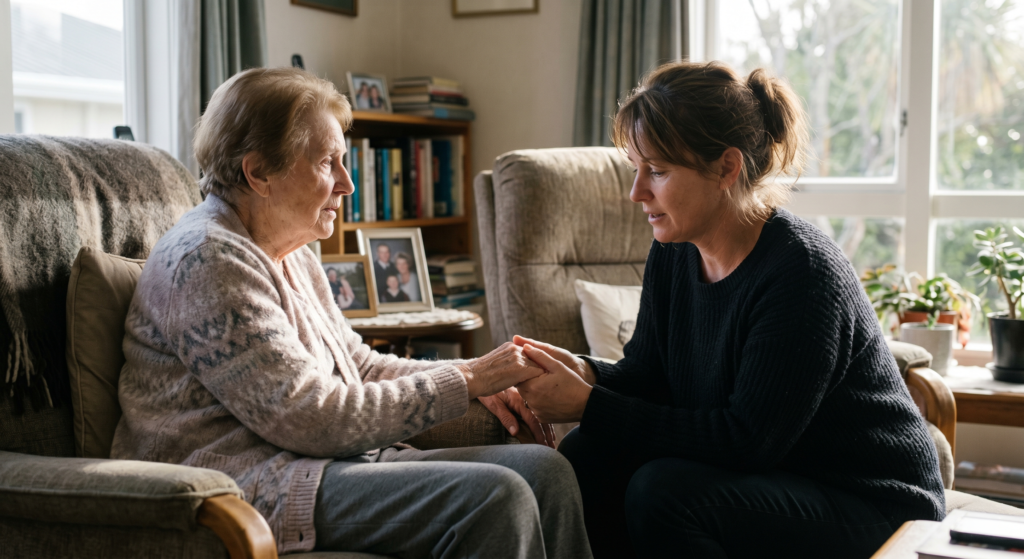
Continuous home support means your parent stays in their own home. Your parent wakes up in their own bed. They sit in their own chair and remain surrounded by familiar belongings. Familiar faces, routines, and surroundings help preserve a sense of identity that institutional environments often struggle to maintain. For someone living with dementia, this familiarity is not just comforting — it is clinically meaningful.
| Feature | 24/7 Home Care | Residential Care / Rest Home |
|---|---|---|
|
Familiar environment |
✓ Own home, own space |
✗ New facility setting |
|
Personalised carer continuity |
✓ Consistent team |
✗ Rotating staff teams |
|
Flexibility of support |
✓ Fully tailored |
✗ Fixed routines |
|
Family involvement |
✓ Open, direct communication |
✗ More structured communication |
|
Overnight supervision |
✓ Included |
✓ Included |
|
Independence preserved |
✓ High |
✗ Often reduced |
The Emotions Families Don’t Talk About
Families often describe the decision to arrange 24/7 support as one of the most emotionally complex experiences of their lives. What’s rarely said aloud is that some of those emotions are contradictory — and that’s completely normal.
Families often experience guilt. Relief can also appear unexpectedly. Many grieve the parent they knew before dementia or a fall changed everything. Others feel a sense of gratitude when the right support finally arrives and the household — and the relationship — begins to breathe again.
Common Emotions at This Stage
- Guilt — “Should I be doing this myself?” The answer is almost always: you’ve already been doing far more than most.
- Fear — Of strangers in the home. Of the cost. Of what it means for the future.
- Grief — Acknowledging that your parent now needs this level of support is a quiet form of loss.
- Relief — And it’s allowed. Knowing someone qualified is there overnight is not betrayal. It’s love.
- Uncertainty — About quality, about communication, about whether it will truly work.
When Is the Right Time for 24/7 Care?
One of the most common things families say, after arranging continuous care is: “I wish we’d done it sooner.” The decision is often delayed — out of hope that things will stabilise, out of reluctance to change the family dynamic, or simply because the daily creep of decline is hard to see clearly when you’re inside it.
There is no perfect moment. But there are indicators that the time has come.
Signs That 24/7 Support May Be Needed
- Falls have occurred more than once, especially overnight
- Wandering behaviour is present, particularly at night — a serious risk for those living with dementia
- Medication is being forgotten or taken incorrectly
- The person can no longer be safely left alone for more than a few hours
- Family caregivers are showing signs of exhaustion, burnout, or resentment
- Hospital discharge is imminent and in-home recovery support is required
- A GP, occupational therapist, or NASC assessor has raised concerns about safety
In Christchurch and Tauranga — where GP shortages and hospital discharge pressures are very real — the ability to arrange private 24/7 support quickly can make a significant difference to outcomes, both medical and emotional.
How 24/7 Care Is Structured in Practice
A well-coordinated around-the-clock support arrangement involves more than simply having someone present at all times. It requires continuity, communication, and care planning that genuinely includes the family.
What a 24/7 Arrangement Typically Includes
- Rotating teams of carers, chosen for continuity and compatibility
- Overnight monitoring — presence in the home throughout the night
- Morning and evening personal care, meals, and medication prompts
- Dementia-specific supervision, including safe wandering management
- Regular family updates and clear communication channels
- Coordination with allied health professionals — physiotherapists, podiatrists, and occupational therapists — where required
- Flexibility to scale support up or down as needs change
Managing Caregiver Guilt
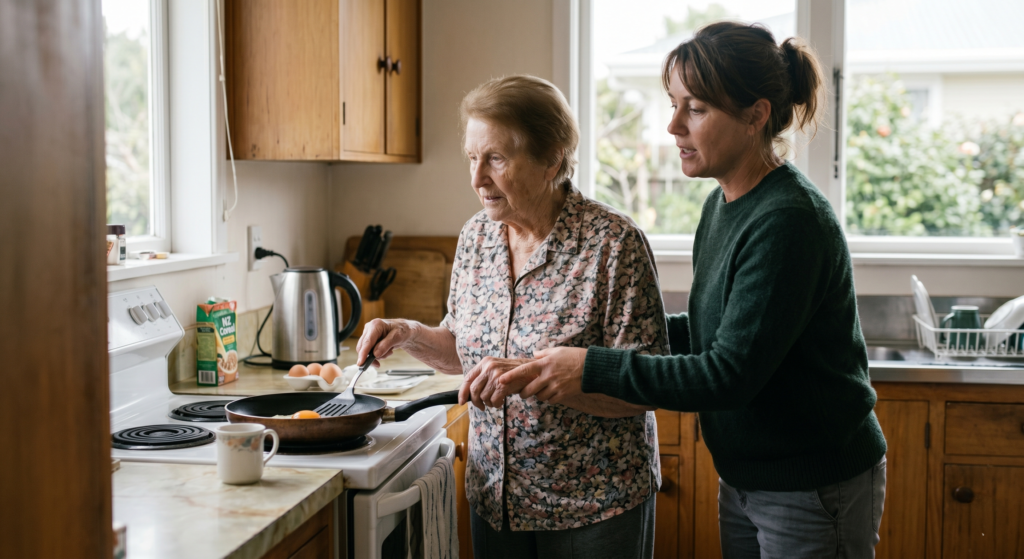
If you have been the primary caregiver for a parent — managing visits, coordinating appointments, and filling in gaps — you are likely running on a kind of quiet determination that most people around you don’t fully see. When that caregiving role changes or professional support is introduced, something unexpected often happens: the guilt intensifies rather than fades.
This is recognised widely among care researchers and support organisations, including Carers New Zealand, which documents the toll of sustained informal caregiving on families. Caregiver burnout is not a personality failing. It is a physiological and emotional reality that emerges when support demands consistently exceed personal capacity.
Bringing in professional 24/7 support is not the end of your role. In practice, many family caregivers describe it as a transformation — from daily crisis management to genuine quality time with their parent, without the weight of sole responsibility.
Choosing the Right 24/7 Care Provider
Not all home care arrangements are the same, and the quality of the experience — for both your parent and your family — depends substantially on who is providing the care and how the arrangement is managed.
Questions Worth Asking a Provider
- How do you ensure continuity of carers — will my parent see the same faces regularly?
- How do you communicate with families — what does a normal week of updates look like?
- Are your carers experienced in dementia supervision and overnight support?
- How quickly can support be arranged — is there capacity for urgent situations?
- Can support be scaled over time as needs change?
- Do you coordinate with other health professionals such as physiotherapists or occupational therapists?
In Christchurch and Tauranga, families increasingly seek support providers who can move quickly, communicate well, and provide genuine relationship-based care — not just task-based assistance.
A Note on Dementia and Overnight Safety
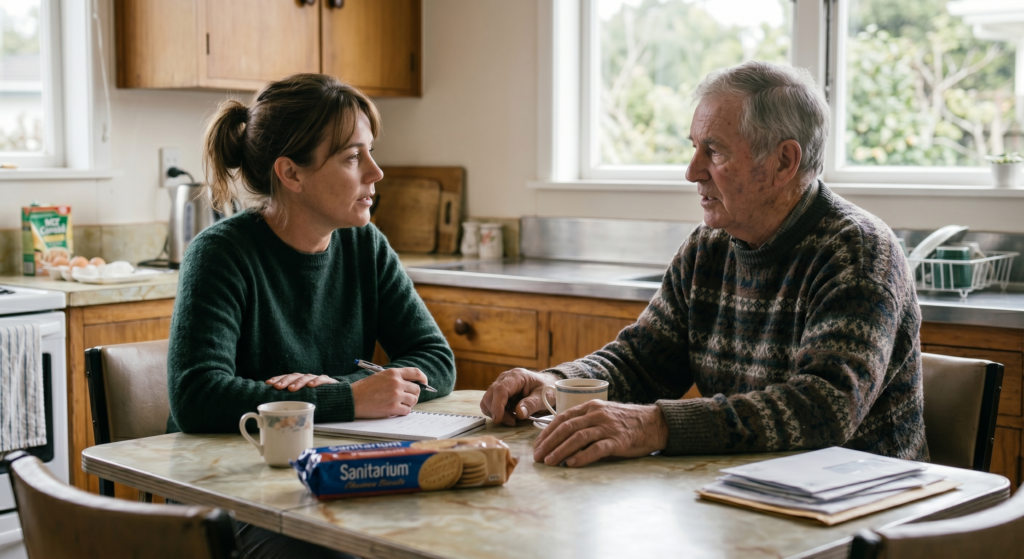
Dementia introduces a specific layer of complexity to night-time supervision. Wandering — one of the most common and dangerous behaviours associated with dementia — most frequently occurs between the hours of dusk and early morning. Standard visiting care arrangements, even several times daily, leave significant gaps in supervision.
For families caring for a parent with dementia in Christchurch or Tauranga, 24/7 home care offers something that visiting care simply cannot: a consistent, attentive human presence throughout the night. This is about more than physical safety. It is about reducing the profound distress that can accompany night-time confusion — and reducing the toll on family members who have previously been managing night-time disturbances themselves.
Dementia New Zealand recommends structured, person-centred care that preserves routine and familiarity — something 24/7 home support is uniquely positioned to provide.
🌐 TRUSTED NEW ZEALAND RESOURCES
- Dementia New Zealand — Support, resources, and helpline for families
- Carers New Zealand — Caregiver wellbeing, rights, and support
- Health NZ / Te Whatu Ora — Hospital discharge and rehabilitation information
- Age Concern New Zealand — Falls prevention and healthy ageing guidance
- Health Navigator NZ — Dementia — Clinical information and symptom guidance
Is Your Parent Safe at Home Right Now?
If you’re considering 24/7 care at home for a parent in Christchurch or Tauranga, Home Carers can help you understand what’s possible — quickly, clearly, and without pressure. From overnight supervision and dementia support to full around-the-clock care, we help families move forward with confidence.
YOU CAN ALSO REACH US DIRECTLY
Frequently Asked Questions
When should a parent have 24/7 care at home?
If your parent has had repeated falls, is living with dementia and wandering at night, cannot safely be left alone for more than a few hours, or is being discharged from hospital and requires close support — these are strong indicators that continuous care at home is appropriate. A NASC assessment or GP recommendation can also help guide the decision.
What is the difference between 24/7 home care and a rest home?
24/7 home care means your parent remains in their own home, with a consistent team of carers providing continuous support. A rest home is a residential facility. For many families — particularly those with a parent experiencing dementia — remaining at home in a familiar environment produces significantly better outcomes and quality of life.
How much does 24/7 home care cost in Christchurch or Tauranga?
Costs vary depending on the level of support required and whether care is funded through public channels or privately. Home Carers provides transparent private pricing — visit our pricing page for details, or call 0800 227 686 to discuss your situation.
Can 24/7 care be arranged quickly in New Zealand?
Private home care providers like Home Carers can typically arrange support significantly faster than public NASC pathways, which often involve waitlists. For urgent situations — including hospital discharge or sudden decline — contact Home Carers directly to discuss what support options may be available.
Can 24/7 care help prevent admission to a rest home?
Yes. Continuous home support is one of the most effective ways to extend the period an older person can remain safely and comfortably at home. With the right team, many people who might otherwise transition to residential care are able to continue living independently — with round-the-clock support.
Will carers be consistent, or will different people turn up each day?
Continuity of carers is one of the most important factors in quality home care — and it is something Home Carers actively builds into its arrangements. Consistent relationships between carers and clients improve safety, comfort, and outcomes, particularly for those living with dementia.
Is 24/7 home care available for dementia patients?
Yes. Home Carers provides dementia-specific 24/7 home care across Christchurch and Tauranga, including overnight supervision, wandering management, and support that preserves routine and dignity. Learn more about our dementia care services on the dementia care page.